












American Grid Crossword Generator
American crossword construction begins differently from ordinary crossword creation.
In many educational or casual crossword tools the creator starts with words first. Answers are entered, clues are prepared, and the grid adapts around the content.
American crosswords often reverse that logic. The grid comes first.
These modes allow the same crossword platform to support classroom worksheets, printable packs, educational resources, puzzle books, American crossword layouts, and larger publishing projects.
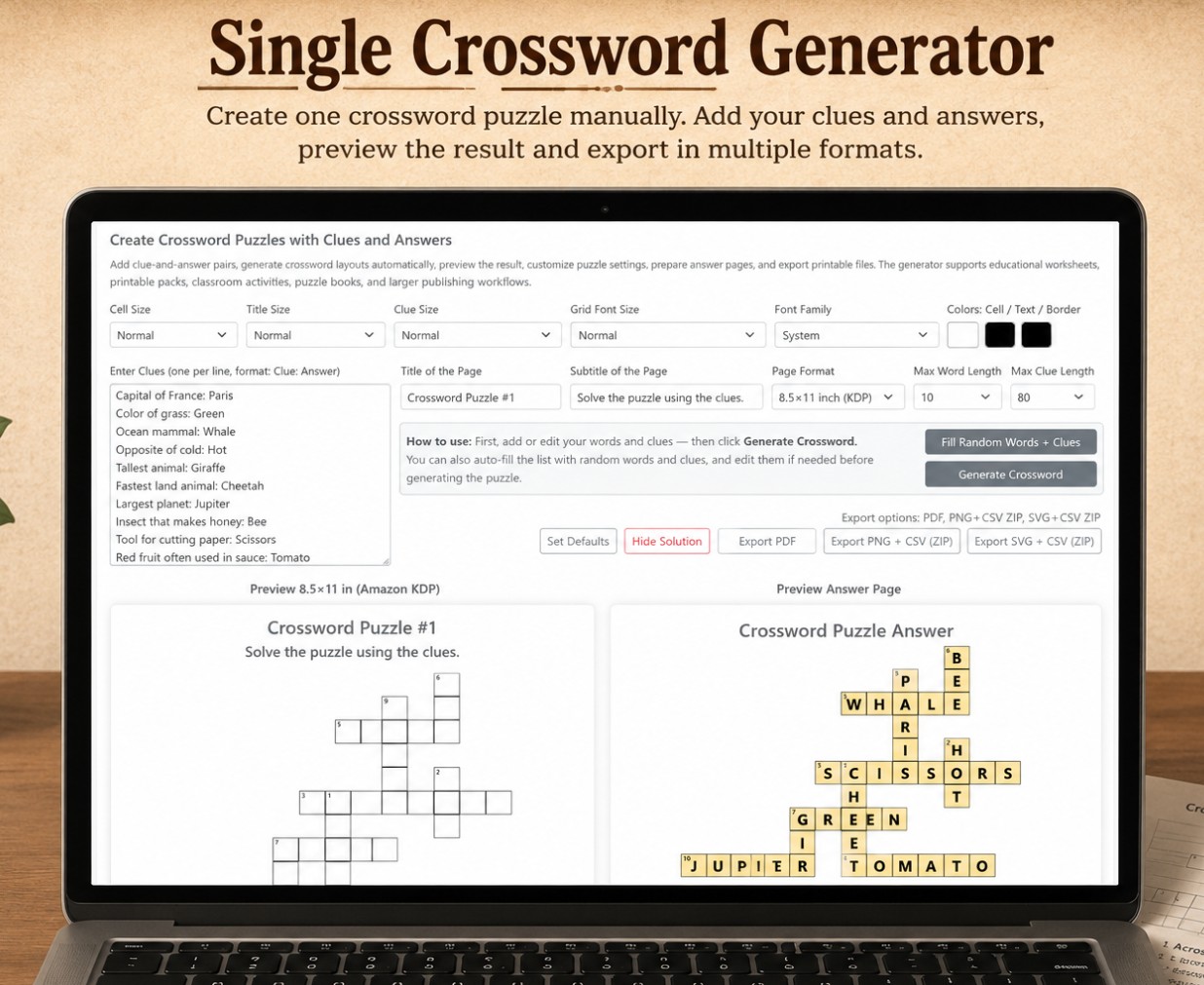
Single Generator
Manual creation mode
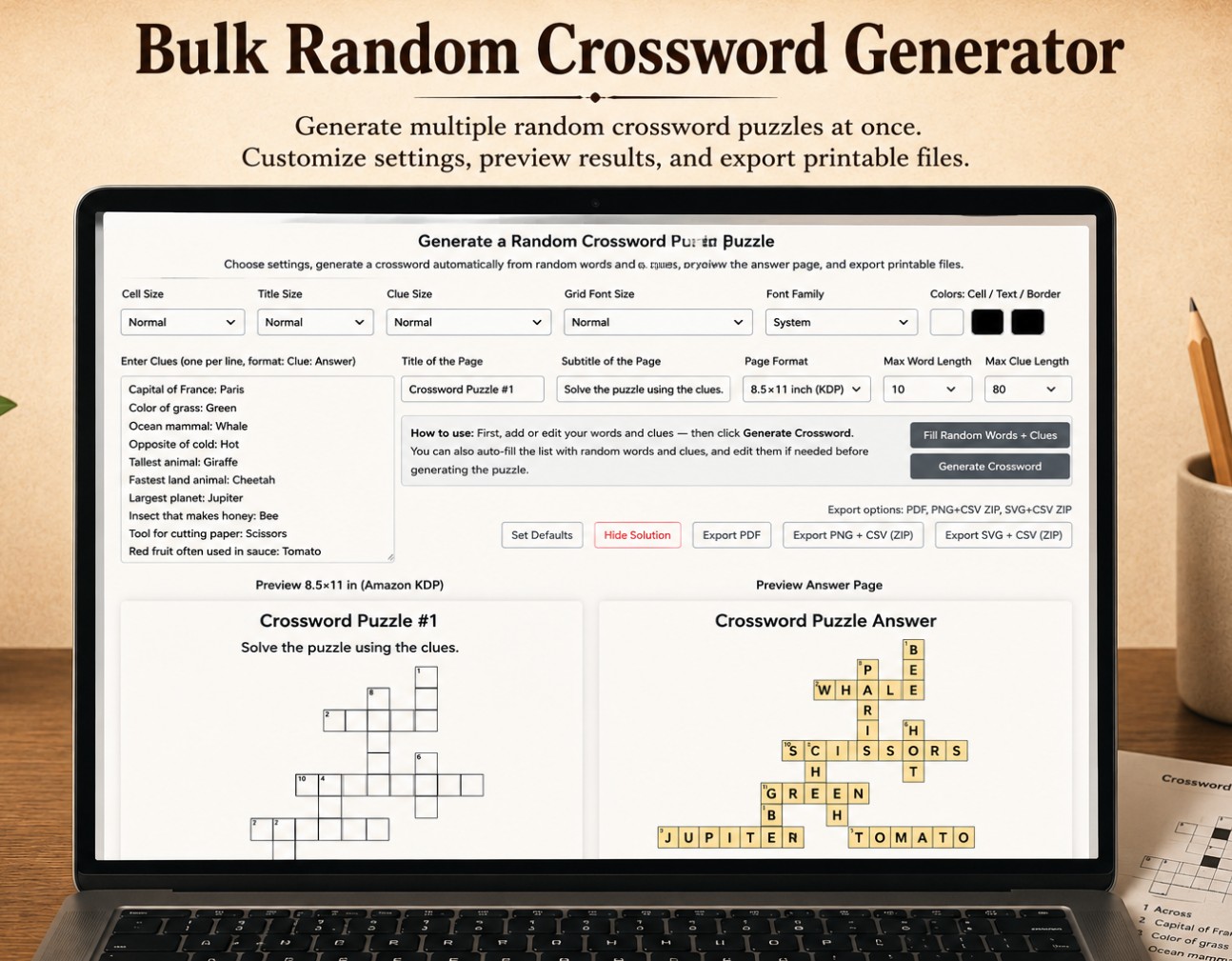
Multi Generator
Bulk puzzle workflow
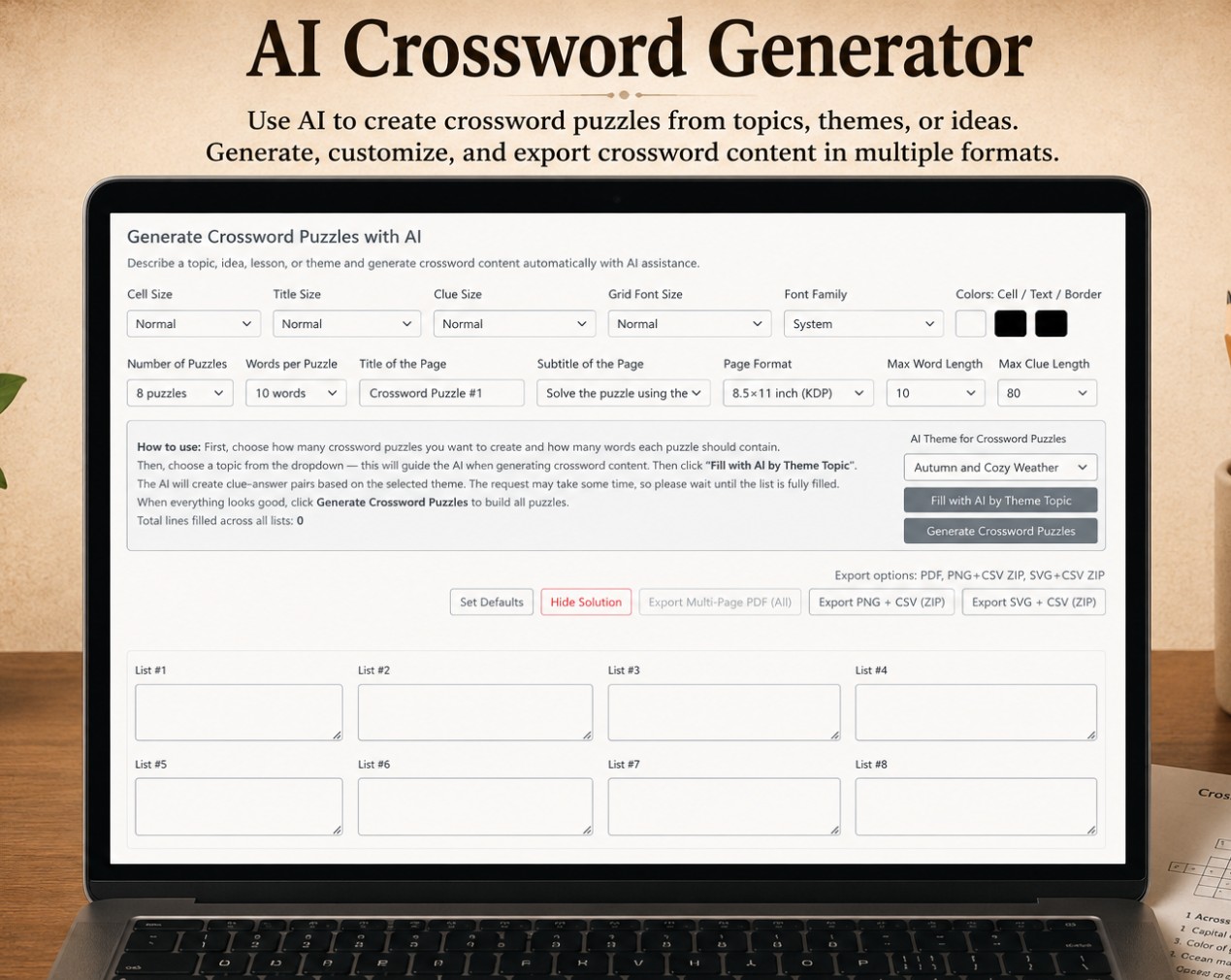
AI Generator
Theme-assisted generation
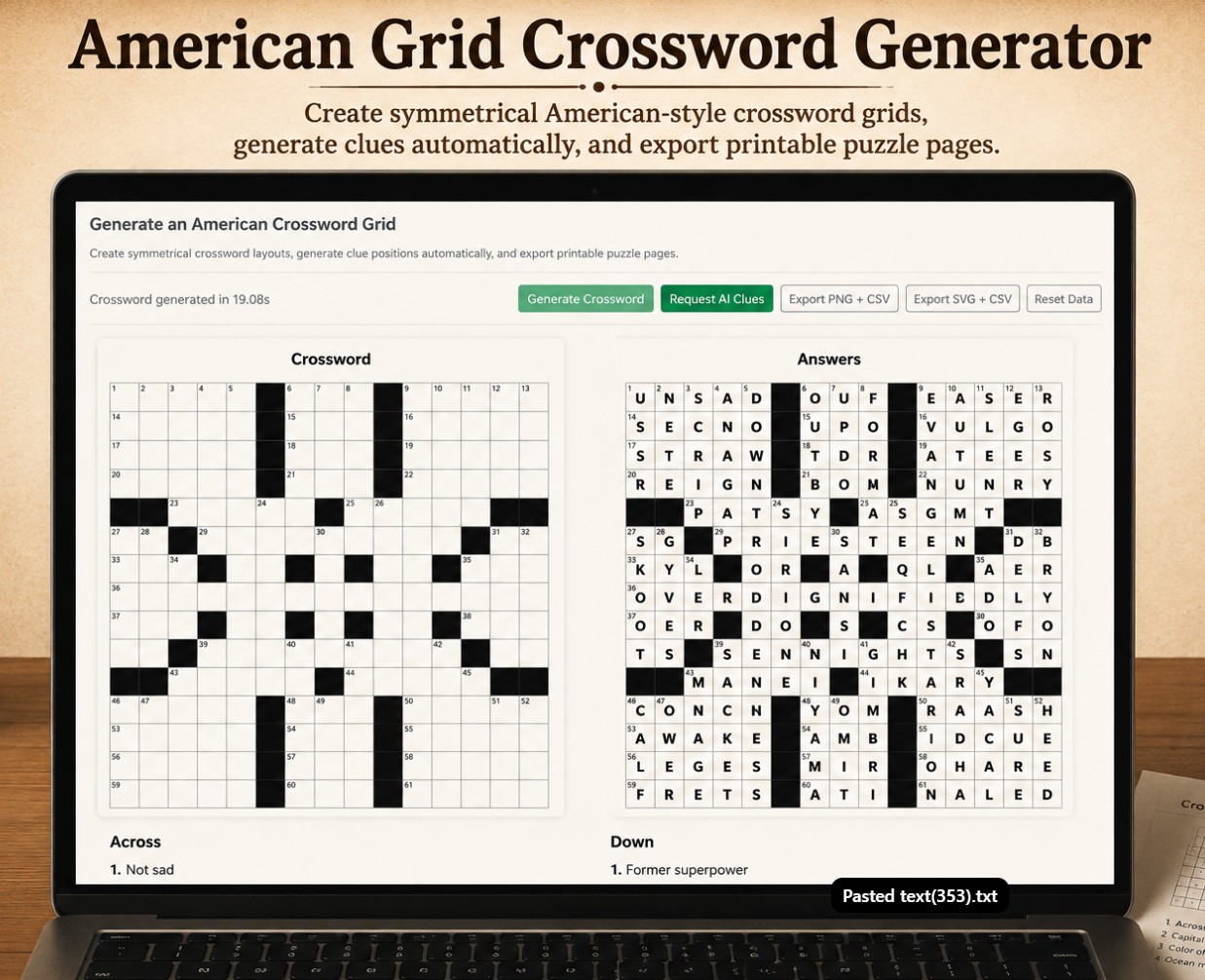
American Grid
Symmetrical crossword layout
Single Generator focuses on precision. You define the clue-and-answer pairs yourself and control the final puzzle structure. This mode works best for worksheets, classroom activities, ESL lessons, vocabulary review, and custom printable pages where accuracy matters.
Multi Generator is designed for larger workflows. Instead of creating one crossword at a time, you can prepare multiple puzzles inside one project. This is useful for printable packs, activity books, classroom collections, and publishing pipelines.
AI Generator helps accelerate content creation by generating themed clue and answer ideas. Holiday topics, science lessons, animals, travel, educational themes, and puzzle collections become faster to prepare.
American Grid Generator is built for creators who want a more traditional American-style crossword structure. It focuses on symmetrical grid layouts, clue positions, black-square patterns, answer pages, and cleaner puzzle-book style output. This mode is especially useful for professional crossword pages, puzzle books, printable publishing projects, and American crossword grid layouts.
Constructors think about symmetry, black squares, connectivity, answer flow, and publishing structure before the puzzle is fully filled. The crossword is treated less like a worksheet and more like an architectural layout.
Searches such as American Grid Crossword Generator, American Crossword Grid, American Style Crossword Generator, Newspaper Crossword Layout, and American Crossword Maker usually point toward this constructor mindset.
Grid → Symmetry → Fill → Clues → Layout → Publishing
The grid becomes the foundation. Everything else grows around it.
American construction workflows naturally continue into American Style Crossword Generator and Crossword 15x15 Generator.
Symmetrical Grids
Build layouts using traditional rotational symmetry rules.
Black Squares
Structure answer flow and visual balance inside the grid.
Constructor Logic
Design the crossword as a system instead of isolated words.
Publishing Layouts
Prepare pages for newspapers, books, and magazines.
American grids are recognized instantly because of their visual discipline. Rotational symmetry, carefully placed black cells, and balanced fill patterns create the newspaper appearance many solvers already expect.
This visual language matters because American crosswords are not only puzzle formats. They are publishing formats. Readers encounter them in newspapers, magazines, books, printable collections, and Sunday puzzle sections.
Building Real Newspaper Style Grids
Newspaper crosswords are rarely random collections of words. Constructors intentionally shape the grid to control solving experience, clue rhythm, and answer distribution.
Black squares determine movement through the puzzle. Symmetry controls appearance. Fill density influences solving difficulty. Grid dimensions affect pacing and publishing format.
| Grid Element | Purpose |
|---|---|
| Rotational symmetry | Traditional American appearance |
| Black cells | Control structure and answer flow |
| Dense intersections | Improve solving connectivity |
| Numbered clues | Support navigation |
| Grid size | Define publishing format |
The result is a crossword that feels structured before the first clue is even solved.
Ordinary crossword workflows begin with vocabulary. American crossword workflows begin with the grid itself.
What Makes American Crosswords Different
American crosswords follow a construction philosophy that differs from many educational, printable, and free-form crossword styles.
The difference is not only visual. It affects how the puzzle is planned, filled, solved, and published.
In educational crosswords the objective is often vocabulary practice. In American crosswords the objective expands toward structure, symmetry, solver flow, and publishing quality.
Constructors therefore think about grid behavior before thinking about individual words.
Rotational Symmetry
Black cells mirror around the grid center creating the classic American appearance.
Dense Intersections
Answers cross frequently to improve solving flow and connectivity.
Publishing Layout
Grids are prepared with newspapers, books, and magazines in mind.
One of the strongest visual signals is rotational symmetry. If a black square appears in one area of the grid, another square often appears in the mirrored position. This creates the balanced look associated with newspaper crosswords.
Symmetry is not only decorative. It creates rhythm, improves visual consistency, and supports traditional construction standards expected by experienced solvers.
American workflows naturally continue into American Style Crossword Generator, where constructor logic and publishing standards become even more visible.
| Element | Educational Crossword | American Crossword |
|---|---|---|
| Priority | Vocabulary | Grid structure |
| Black cells | Functional only | Structural element |
| Symmetry | Optional | Common standard |
| Publishing role | Worksheets | Newspapers and books |
American crosswords therefore feel different because the constructor designs the framework first and fills the content second.
American Construction Workflow
Building an American crossword usually follows a structured sequence. Constructors do not randomly add words until the puzzle looks complete.
The workflow begins with architecture.
Step 1 — Choose the Grid
The grid defines almost everything that follows. Daily puzzles often move toward 15x15 layouts, while larger Sunday projects expand toward bigger publishing formats.
Daily construction workflows continue into Crossword 15x15 Generator.
Step 2 — Place Black Squares
Black cells shape the puzzle. They define answer lengths, control movement, influence difficulty, and create the visual identity of the grid.
Step 3 — Apply Symmetry
Rotational symmetry mirrors black cells across the grid and produces the classic newspaper appearance expected from American-style crosswords.
Step 4 — Fill the Grid
Constructors place answers while maintaining connectivity and balanced intersections. Fill quality becomes one of the most important parts of the workflow.
Step 5 — Add Clues and Numbering
Clues transform structure into solving experience. Numbering organizes navigation and prepares the puzzle for publishing.
Step 6 — Prepare Layouts
The finished grid moves into printable pages, newspapers, books, magazines, and publishing workflows.
Grid → Black Squares → Symmetry → Fill → Clues → Layout → Publishing
The important shift is that American construction treats the crossword as a designed system.
Words fill the grid, but the grid defines the crossword.
American Style Crosswords
American crosswords are often recognized immediately even before a solver reads the first clue.
The grid looks balanced. Black squares feel intentional. Intersections appear dense. The page carries the visual language people associate with newspapers, magazines, and classic puzzle books.
This happens because American crossword construction follows style rules instead of only filling words into open space.
The constructor is not simply making a puzzle. The constructor is shaping an experience.
Style-focused workflows continue into American Style Crossword Generator.
Symmetry
Rotational balance creates the classic newspaper appearance.
Connectivity
Dense intersections support solving flow.
Publishing Structure
Layouts fit newspapers, magazines, and books.
One important idea is that American style affects everything downstream. Symmetry influences black cell placement. Black cells influence answer lengths. Answer lengths influence fill quality. Fill quality changes clue rhythm and solving difficulty.
Small structural choices ripple through the entire crossword.
This is why experienced constructors often spend significant time adjusting grids before final fill begins. The structure must feel correct first because later publishing stages depend on it.
Structure → Fill → Solving Experience → Publishing Quality
American style therefore becomes more than appearance. It becomes the design system behind the crossword.
Daily 15x15 Crossword Workflow
If one format defines American crossword construction, it is usually the 15x15 grid.
Daily newspaper puzzles commonly use 15 rows by 15 columns because the size balances complexity and readability. The grid feels large enough to support meaningful construction while remaining comfortable for everyday solving.
Daily workflows continue into Crossword 15x15 Generator.
| Format | Typical Use | Style |
|---|---|---|
| 15x15 | Daily newspapers | Standard American |
| Mini | Fast solving | Compact grids |
| 21x21 | Sunday puzzles | Extended layouts |
The popularity of 15x15 comes from balance.
Smaller grids may feel too short for richer construction. Larger grids demand more fill quality and more editing effort. The daily format sits between those extremes.
Publishers also prefer it because the format fits newspaper sections, books, magazines, printable pages, and puzzle collections without major layout changes.
For many constructors the 15x15 grid becomes the laboratory where themes, symmetry, fill strategies, and clue workflows are tested.
Sunday Crossword Systems
Sunday crosswords expand the same construction principles into larger spaces.
Bigger grids create more room for themes, reveals, longer answers, visual patterns, and advanced constructor ideas. The puzzle gains scale while still preserving American style rules.
Sunday workflows continue into American Sunday Crossword Generator, Crossword 21x21 Generator, and Sunday Crossword Maker.
Larger Grids
More space for answers and themes.
Longer Entries
Support reveals and thematic content.
Publishing Scale
Designed for Sunday sections and books.
Advanced Construction
More room for constructor creativity.
Sunday puzzles are not simply bigger versions of daily crosswords.
The extra space changes strategy. Constructors gain room for narrative themes, linked answers, long reveals, and more ambitious fill structures.
Daily grids optimize balance. Sunday grids optimize possibility.
Mini and Compact Grids
Smaller American crossword grids may look easier because they contain fewer cells, but constructors often experience the opposite effect.
Large grids provide room for correction. Constructors can move entries, adjust black squares, and redistribute fill. Mini grids remove that freedom very quickly. Every cell becomes more important because there is less space available for structural compromises.
A compact crossword therefore stops being a reduced puzzle and becomes a precision puzzle.
Compact workflows continue into American Mini Crossword Generator and Mini Crossword Maker.
Compact Layouts
Smaller grids reduce space but increase precision requirements.
Dense Fill
Intersections become more important in limited layouts.
Fast Solving
Short sessions fit modern puzzle habits.
Mini crosswords have become increasingly popular because many solvers no longer approach puzzles as long newspaper sessions. They solve during short breaks, mobile sessions, morning routines, and quick daily habits.
The constructor challenge therefore changes. The goal becomes creating strong structure inside a compressed environment while preserving American crossword quality.
Less Space → Tighter Structure → Higher Fill Precision → Faster Solving
Small grids do not reduce craftsmanship. They concentrate it.
Themed American Crosswords
Themes change the purpose of the crossword grid.
In a standard puzzle the grid mainly supports words and clues. In a themed puzzle the grid begins supporting an idea. Answers become connected. Structure becomes narrative. The constructor starts designing relationships instead of isolated entries.
Theme workflows continue into Themed Crossword Generator.
Reveal Entries
Central answers explain the hidden idea.
Linked Answers
Entries cooperate around one concept.
Theme Structure
Layout decisions follow narrative logic.
Publishing Value
Themes organize books and collections.
Themes frequently reshape construction itself. Long reveal entries may force black cell movement. Symmetry may need rebalancing. Fill becomes more constrained because thematic answers receive priority.
The constructor therefore solves two problems simultaneously: preserving the theme while maintaining grid quality.
The result feels different to solvers. Instead of independent clues they experience a connected idea unfolding across the grid.
Themes become especially valuable in publishing because they naturally organize books, magazine sections, holiday collections, and puzzle series.
Symmetry Rules and Constructor Standards
American crossword grids feel recognizable because constructors repeatedly return to a shared set of structural principles.
These standards help maintain visual balance, solving quality, readability, and publishing consistency. They are not rigid laws, but they shape what solvers expect from American crossword construction.
| Rule | Purpose |
|---|---|
| Rotational symmetry | Preserve classic newspaper appearance |
| Black cell balance | Control structure and rhythm |
| Connectivity | Keep all answers linked |
| Dense intersections | Improve solving support |
| Numbering logic | Support clue navigation |
| Publishing layout | Prepare grids for books and newspapers |
Constructors balance these rules continuously. Theme requirements, fill quality, difficulty targets, and publishing goals sometimes push the grid in different directions.
The skill lies in keeping those forces aligned while preserving American crossword identity.
Ordinary crossword creation often begins with words. American construction begins with standards that shape those words before they ever appear inside the grid.
American Publishing Workflow
American crossword construction naturally leads toward publishing because the format itself was shaped by publishing environments.
Newspaper pages, magazine sections, Sunday supplements, puzzle books, and printable collections helped define how American grids evolved. Symmetry, clue numbering, black cells, and grid dimensions were not created randomly. They developed because the format needed to work repeatedly in print.
This is why American grids feel immediately familiar. Solvers have seen them for decades in newspapers and puzzle books.
Modern creators continue the same workflow, but now publishing extends beyond newspapers into KDP interiors, printable packs, digital collections, magazines, and puzzle catalogs.
Publishing workflows continue into Crossword Book Generator and Printable Crossword Generator.
Grid → Fill → Clues → Layout → Book → Publishing
Newspapers
Traditional daily and Sunday crossword publishing.
Puzzle Books
Collections built around American layouts.
KDP and Printables
Reusable publishing workflows and catalogs.
The publishing process also changes how constructors think. They stop asking whether the crossword works alone and start asking whether the crossword works inside a collection.
One 15x15 grid becomes a page. Multiple pages become sections. Sections become books. Books later become product lines and reusable publishing systems.
American crossword construction therefore scales naturally because the format already evolved inside publishing ecosystems.
American Hub Ecosystem
American crossword construction rarely stays inside one format.
Constructors often begin with standard grids, then move into daily layouts, Sunday systems, mini formats, themed construction, and publishing workflows. The American Hub connects those paths into one constructor ecosystem.
American Style Crossword Generator
Continue traditional constructor workflows.
Crossword 15x15 Generator
Build classic daily layouts.
American Sunday Crossword Generator
Expand into larger publishing grids.
Crossword 21x21 Generator
Build Sunday-size layouts.
American Mini Crossword Generator
Explore compact constructor formats.
Mini Crossword Maker
Create smaller solving experiences.
Themed Crossword Generator
Build narrative and reveal workflows.
Sunday Crossword Maker
Create advanced Sunday projects.
American Hub therefore becomes more than a list of page types. It becomes a constructor toolkit covering scale, style, and publishing paths.
Building Grids Before Words
Educational crossword workflows often begin with vocabulary.
American crossword workflows begin with the grid.
Constructors establish symmetry, define structure, shape answer flow, balance black squares, and only then begin filling entries.
Grid → Symmetry → Fill → Clues → Layout → Publishing
This reversal changes everything because the crossword stops being a collection of words and becomes a designed system.
Ordinary crosswords build entries. American crosswords build grids first and let the entries live inside them.