













What Is Sudoku and Why It Is So Popular
Sudoku is a logic-based number puzzle where players fill a grid using digits from 1 to 9 while following a small set of simple rules. At first glance, the puzzle may look easy, but solving it requires careful observation, logical thinking, and step-by-step reasoning rather than guessing.
A standard Sudoku puzzle consists of a 9×9 grid divided into rows, columns, and smaller 3×3 regions. Some numbers are already placed in the grid at the start. These starting clues guide the player and make each puzzle solvable through logic alone.
One of the key reasons Sudoku became popular worldwide is its perfect balance between simplicity and depth. The rules can be learned in minutes, but mastering the puzzle can take much longer as players discover new strategies and patterns.
Sudoku is also widely used as a form of mental training. Solving puzzles helps improve concentration, pattern recognition, and logical thinking skills. Because of this, Sudoku is enjoyed by both casual players and people looking to develop structured problem-solving abilities.
For beginners, learning Sudoku usually starts with understanding how the grid works and how numbers interact across rows, columns, and regions. From there, players gradually move from simple placements to more structured solving techniques.
Basic Sudoku Rules Explained
Sudoku is built on a very small set of rules, which makes it easy to learn even for complete beginners. Every move you make in the puzzle is based on how numbers interact across rows, columns, and 3×3 regions.
The goal is simple: fill the entire grid so that each number appears only once in every row, column, and region. Even though the rules are minimal, they create a powerful logical system that allows every puzzle to be solved step by step.
The three fundamental Sudoku rules:
- Each row must contain numbers 1–9 exactly once.
- Each column must contain numbers 1–9 exactly once.
- Each 3×3 region must contain numbers 1–9 exactly once.
When you place a number in a cell, that number can no longer appear in the same row, column, or region. This restriction is what drives all Sudoku logic and helps you eliminate incorrect possibilities.
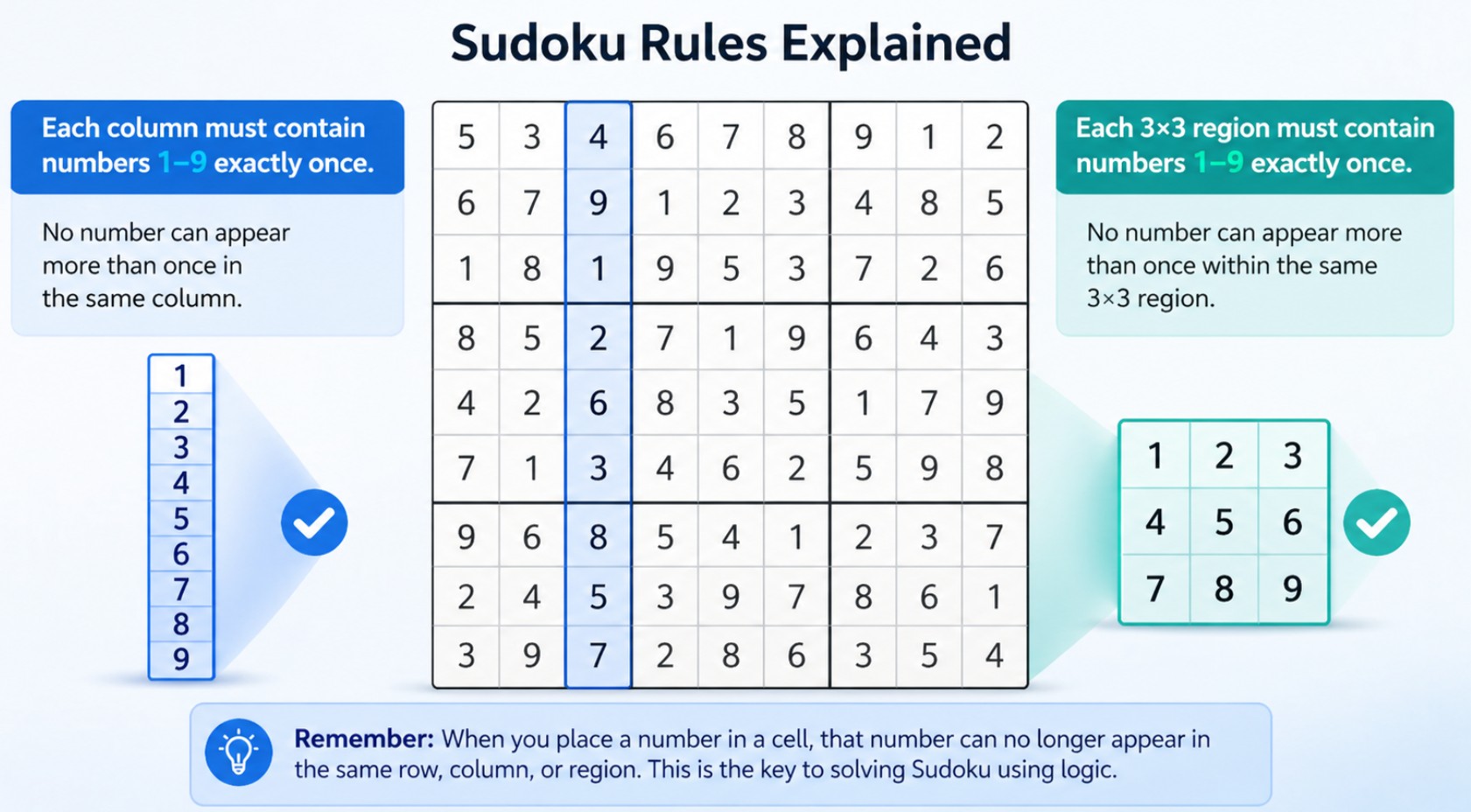
Example of a Sudoku Puzzle Grid
This example shows a typical Sudoku puzzle with some numbers already filled in. By applying the three core rules, you can logically determine where the remaining numbers should be placed.
How the rules work together
| Area | Rule | What It Means |
|---|---|---|
| Row | No duplicate numbers | Numbers 1–9 appear once across the row |
| Column | No duplicate numbers | Numbers 1–9 appear once vertically |
| Region | No duplicate numbers | Numbers 1–9 appear once inside each 3×3 box |
Once you understand these three rules and how they interact, you already have everything you need to start solving Sudoku puzzles using logic instead of guessing.
How Beginners Start Solving Sudoku
Most beginners do not start with advanced techniques. Instead, they begin by scanning the grid and looking for obvious placements. This means identifying which numbers are already present in a row, column, or region and determining which number is missing.
The key idea is simple: every number you place must follow the three Sudoku rules. By checking all constraints step by step, you can find correct placements without guessing.
A simple beginner-friendly solving flow:
- Step 1: Scan a row. Look for a missing number and identify whether only one position is possible.
- Step 2: Check the column. Make sure the number does not already appear vertically.
- Step 3: Check the 3×3 region. Confirm the number fits within its local box.
- Step 4: Place the number. If all conditions are satisfied, the placement is correct.
This step-by-step process is the foundation of Sudoku solving. As you repeat it across the grid, the puzzle gradually becomes clearer and easier to complete.
Common Sudoku Mistakes Beginners Make
Many beginners struggle with Sudoku not because the puzzle is too difficult, but because they approach it incorrectly. Understanding common mistakes can help you avoid frustration and improve faster.
- Guessing instead of using logic. Sudoku is designed to be solved logically. Guessing often leads to mistakes later in the puzzle.
- Ignoring 3×3 regions. Beginners often focus only on rows and columns, forgetting that regions are equally important.
- Not scanning the whole grid. Focusing on one area too long can make you miss easier placements elsewhere.
- Placing numbers too quickly. Always double-check row, column, and region before placing a number.
Avoiding these common mistakes will make Sudoku much easier and more enjoyable. As you gain experience, you will naturally rely more on logic and less on trial and error.
What beginners usually focus on first
Rows with Many Numbers
Rows that already contain several numbers are easier to complete because fewer possibilities remain.
Nearly Completed Columns
Columns with only one or two empty cells often reveal obvious placements quickly.
3×3 Regions
Smaller regions help narrow the position of numbers because they limit the available cells for each value.
Easier Puzzles First
Starting with easier Sudoku grids helps beginners learn how the logic works before moving to harder puzzles.
Once players become comfortable with this basic solving flow, they can move on to more structured Sudoku strategies that reveal patterns across multiple rows, columns, and regions.
Step-by-Step Sudoku Solving Example
The easiest way to understand Sudoku logic is to follow one simple placement step by step. Instead of guessing, you compare the row, column, and 3×3 region to see where a number can legally go.
Imagine that a 3×3 region is almost complete and only one number is missing. Before placing that number, you still need to confirm that it does not already appear in the same row or column.
A simple logical placement process:
- Step 1: Choose a missing number. Look at a row, column, or 3×3 region and identify which number is not yet used.
- Step 2: Check the row. Make sure the number does not already appear anywhere across that row.
- Step 3: Check the column. Confirm that the same number is not already placed vertically.
- Step 4: Check the 3×3 region. The number must also be missing from the local box.
- Step 5: Place the number only if one cell is possible.If more than one cell can accept the number, wait and continue scanning.
This example shows the core idea behind Sudoku solving: every placement should be justified by the rules. Even advanced techniques are built on this same foundation of checking, eliminating, and confirming possibilities.
Find What Is Missing
Start with an area that already has many numbers. Fewer empty cells usually means fewer possible choices.
Eliminate Impossible Cells
Use the row, column, and region rules to remove cells where the number cannot legally go.
Confirm Before Placing
Place a number only when the logic leaves one valid position. This keeps the puzzle clean and avoids mistakes.
Practicing this simple process repeatedly helps beginners build confidence. Over time, you will begin to recognize placements faster and move naturally toward more advanced Sudoku strategies.
Sudoku Difficulty Levels Explained
Not all Sudoku puzzles are the same. Difficulty levels determine how much logic and experience is required to solve a puzzle. Understanding these levels helps beginners choose the right starting point and progress more confidently.
Most Sudoku puzzles are grouped into four main difficulty categories. Each level introduces new challenges and requires more advanced thinking.
Easy Sudoku
Designed for beginners. Most numbers can be placed using simple scanning and basic logic without advanced techniques.
Medium Sudoku
Requires more careful observation. Players begin using candidate elimination and comparing multiple cells before placing numbers.
Hard Sudoku
Fewer obvious placements. Solving requires structured thinking, pattern recognition, and the use of more advanced strategies.
Expert Sudoku
Designed for experienced players. Advanced techniques such as pattern-based elimination and multi-step logic are often required.
How to choose the right difficulty
- Start with easy puzzles. Build confidence and understand the rules.
- Move to medium. Practice candidate elimination and scanning.
- Try hard puzzles. Develop structured solving habits.
- Explore expert level. Learn advanced techniques and patterns.
Progressing through difficulty levels naturally improves your Sudoku skills. Each level builds on the previous one, helping you develop faster and more accurate solving techniques.
From Basic Rules to Sudoku Strategies
After learning the basic rules, most players begin to use simple strategies to solve Sudoku more efficiently. These strategies do not introduce new rules — they simply help you apply the existing rules in a more structured way.
At first, strategies are based on observation and elimination. As puzzles become more difficult, players rely on pattern recognition and logical structures that reveal hidden placements across the grid.
Common beginner and intermediate strategies
Basic Scanning
The simplest strategy. You scan rows, columns, and regions to find missing numbers and obvious placements.
Candidate Elimination
Remove impossible options from each cell until only one valid number remains.
Naked Single Technique
A cell can accept only one number after eliminating all other possibilities. This is one of the most common beginner techniques.
Hidden Single Technique
A number can only appear in one position within a row, column, or region, even if that cell is not immediately obvious.
Moving toward advanced techniques
As puzzles become more complex, simple strategies may no longer be enough. Players begin to use advanced techniques that analyze patterns across multiple rows and columns.
Pattern Recognition
Recognizing repeating structures helps identify how one placement affects other parts of the grid.
X-Wing Technique
An advanced method that uses patterns across rows and columns to eliminate candidates and reveal hidden placements.
Learning these strategies step by step allows you to solve more difficult Sudoku puzzles without guessing. Each new technique builds on the same core idea: eliminate what is impossible and confirm what must be true.
Why Sudoku Is Good for Learning and Brain Training
Sudoku is more than just a puzzle game. Many people use it as a simple and effective way to train their thinking skills. Because Sudoku is based entirely on logic, it encourages structured problem-solving without relying on guesswork.
Regular practice helps players become more focused, patient, and confident when working through complex problems step by step.
Skills developed by solving Sudoku
Logical Thinking
Sudoku trains your ability to analyze situations and make decisions based on clear rules and constraints.
Concentration
Solving puzzles requires focus and attention to detail, helping improve your ability to stay engaged on a task.
Pattern Recognition
Over time, players learn to recognize repeating structures and patterns that make solving faster and more efficient.
Patience and Discipline
Sudoku encourages a calm, step-by-step approach, helping develop persistence and careful thinking.
Unlike fast-paced games, Sudoku rewards careful thinking rather than speed. This makes it a great activity for both relaxation and mental engagement.
While Sudoku is not a substitute for professional cognitive training, it is a simple and accessible way to keep your mind active and improve logical reasoning through regular practice.
Explore Sudoku Learning Topics
If you want to understand Sudoku more deeply, explore these learning guides. Each page focuses on a specific part of Sudoku logic — from the basic rules of the puzzle to more advanced solving techniques used in difficult grids.
These guides explain Sudoku step by step and help players move from basic understanding to more structured solving techniques used in harder puzzles.
Practice Sudoku While You Learn
Reading about Sudoku rules and strategies is useful, but real progress usually comes from practice. Once you understand how the grid works, solving actual puzzles helps you apply the rules, improve your pattern recognition, and build confidence step by step.
Many learners find it helpful to practice with easier Sudoku puzzles first, then gradually move to more challenging grids. This creates a natural learning path: understand the rules, solve simple puzzles, recognize common patterns, and only then move to harder strategies.
Combining learning pages with real puzzle practice is often the fastest way to improve. A clear explanation teaches the logic, but repeated solving helps turn that logic into a natural solving habit.