













What Are the Basic Sudoku Rules?
Sudoku is a logic puzzle where the goal is to fill a grid with numbers so that every placement follows a simple set of rules. Unlike math-based games, Sudoku does not require calculations — it relies entirely on logical reasoning and elimination.
A standard Sudoku puzzle uses a 9×9 grid divided into rows, columns, and smaller 3×3 regions. Some numbers are already placed in the grid at the start. These starting numbers are called clues and help guide the solving process.
To complete the puzzle correctly, every number you place must follow the three core Sudoku rules.
The three basic Sudoku rules:
- Each row must contain numbers 1–9 exactly once.No number can repeat within the same horizontal line.
- Each column must contain numbers 1–9 exactly once.No number can repeat within the same vertical line.
- Each 3×3 region must contain numbers 1–9 exactly once.Every smaller box must include all digits without duplication.
These three simple rules define the entire structure of Sudoku. Every correct solution is built by following them consistently and using logic to eliminate impossible placements.
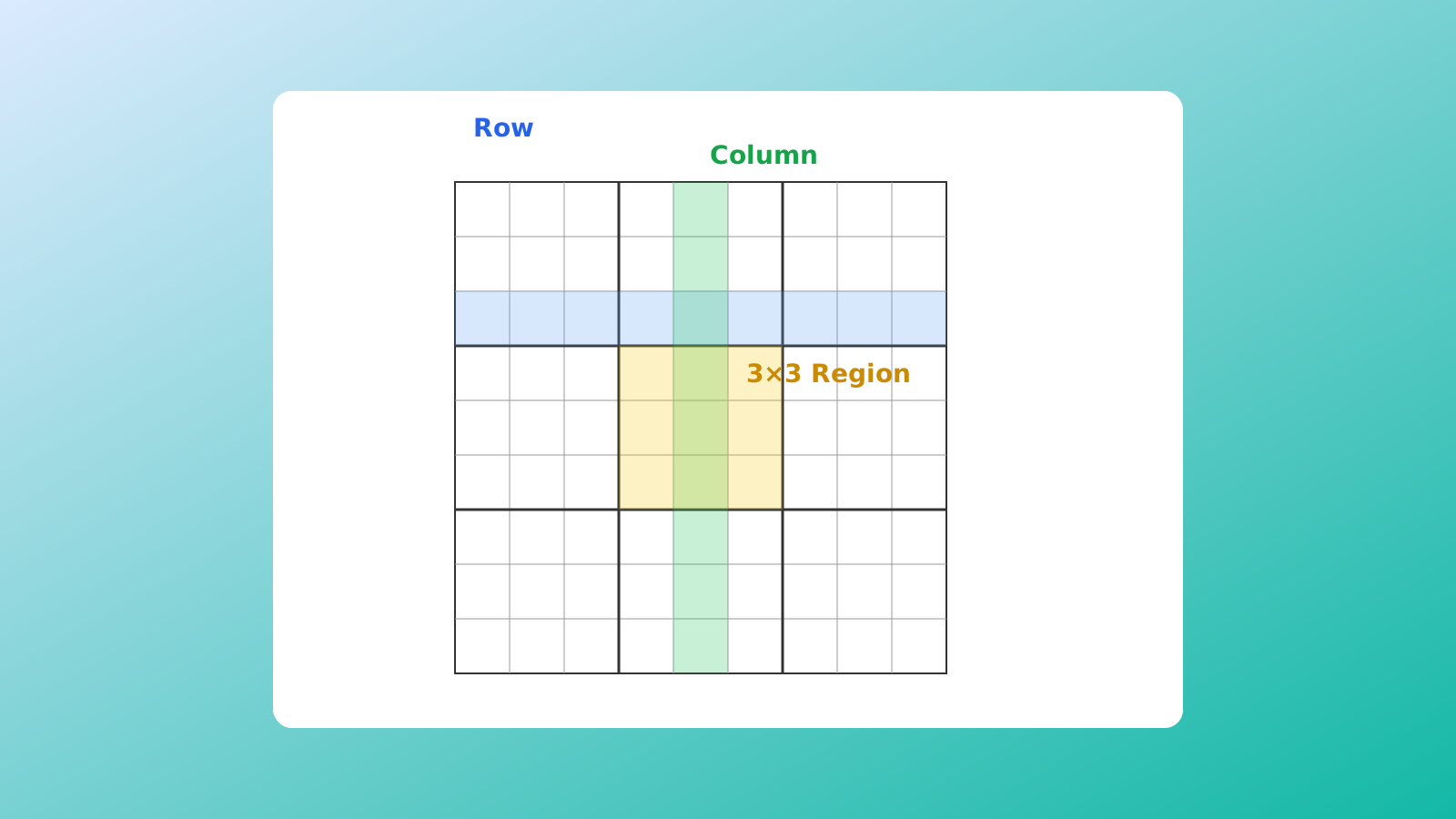
Sudoku Rules Visual Example
This visual example shows how Sudoku rules work across the grid. A number cannot repeat in the same row, column, or 3×3 region. Every correct placement must satisfy all three rules at the same time.
The Three Core Sudoku Rules Explained in Detail
While Sudoku rules are simple, understanding how each one works in practice makes solving much easier. Every number you place must satisfy all three conditions at the same time.
| Area | Rule | What to Check |
|---|---|---|
| Row | No duplicate numbers | Make sure the number does not already exist in the same horizontal line |
| Column | No duplicate numbers | Check that the number is not repeated vertically |
| 3×3 Region | No duplicate numbers | Confirm the number is not already used inside the 3×3 box |
These three checks form the foundation of every Sudoku move. Even if a number looks correct at first glance, it must pass all three conditions before it can be placed in the grid.
How Sudoku Rules Work Together
In Sudoku, rules are not applied separately. Every number you place affects three different areas at the same time: the row, the column, and the 3×3 region. This interaction is what creates the logic of the puzzle.
Row Restriction
When you place a number in a row, that number can no longer appear anywhere else in the same horizontal line.
Column Restriction
The same number is also blocked from appearing anywhere else in the same vertical column.
3×3 Region Restriction
The number cannot be repeated inside its 3×3 box, which further limits possible positions.
Because each placement affects multiple areas at once, Sudoku becomes a puzzle of elimination. By combining all three rules, you can narrow down possibilities until only one correct position remains.
What Makes a Sudoku Move Valid?
Every time you place a number in Sudoku, you are making a logical decision. A move is only valid if it follows all three core rules at the same time.
Instead of guessing, you should always verify your move step by step. This approach prevents mistakes and helps you solve puzzles more efficiently.
A simple checklist for every move:
- Step 1: Choose a number. Identify which number is missing in a row, column, or 3×3 region.
- Step 2: Check the row. Make sure the number is not already used in that row.
- Step 3: Check the column. Confirm the number does not appear in the same column.
- Step 4: Check the 3×3 region. Ensure the number is not present inside the box.
- Step 5: Place the number only if all checks pass.If there is any conflict, the move is not valid.
Valid Move
A number fits the row, column, and region without any duplication.
Invalid Move
A number already exists in at least one of the required areas, breaking the Sudoku rules.
By following this simple process for every move, you can solve Sudoku puzzles logically and avoid errors that come from guessing or skipping checks.
Common Sudoku Rule Mistakes
Most Sudoku mistakes happen when players skip one of the three rule checks. A number may look correct in one area but still break the puzzle in another.
Repeating a Number
Placing the same number twice in one row, column, or 3×3 region immediately breaks the Sudoku rules.
Checking Only One Area
A move must be valid in the row, column, and region. Checking only the row is not enough.
Forgetting the 3×3 Box
Beginners often focus on rows and columns but forget that each 3×3 region also has its own no-repeat rule.
Guessing Too Early
Guessing can create hidden conflicts that only appear later. Sudoku should be solved through logic and elimination.
The safest habit is simple: before placing any number, check the row, the column, and the 3×3 region. This keeps your solution consistent from the first move to the last.
Given Numbers vs Player Entries
Every Sudoku puzzle starts with a set of pre-filled numbers. These are called given numbers or clues. They define the structure of the puzzle and ensure that it has a valid solution.
As a player, your task is to fill in the remaining empty cells using logic, while respecting the original clues and the three Sudoku rules.
Given Numbers (Clues)
These numbers are part of the original puzzle. They cannot be changed or removed and serve as fixed reference points.
Player Entries
These are the numbers you add while solving the puzzle. Every entry must follow all Sudoku rules and be logically justified.
When is a Sudoku puzzle complete?
- All cells are filled. There are no empty spaces left in the grid.
- No rules are broken. Each row, column, and 3×3 region contains numbers 1–9 exactly once.
- All placements are consistent. No duplicates appear anywhere in the grid.
Understanding the difference between fixed clues and your own entries helps you approach Sudoku more carefully and avoid changing values that are meant to stay constant.
Mini Example: Why a Number Cannot Go There
A number may look possible at first, but Sudoku rules can quickly show why it cannot be placed in a certain cell.
Example with the number 7
Imagine you want to place 7 in an empty cell. Before placing it, you must check three areas:
- If 7 already appears in the same row, that cell is not valid.
- If 7 already appears in the same column, that cell is not valid.
- If 7 already appears in the same 3×3 region, that cell is not valid.
This is the basic logic behind Sudoku solving. You are not asking only whether a number fits one place — you are checking whether it fits all required areas at the same time.
Sudoku Rules by Grid Type
While most Sudoku puzzles use a standard 9×9 grid, the same rules can apply to different grid sizes. The only difference is the range of numbers and the size of the regions.
| Grid Size | Numbers Used | Region Layout |
|---|---|---|
| 4×4 | 1–4 | 2×2 boxes |
| 6×6 | 1–6 | 2×3 boxes |
| 9×9 | 1–9 | 3×3 boxes |
| 16×16 | 1–16 (or symbols) | 4×4 boxes |
No matter the grid size, the core rule remains the same: each number must appear exactly once in every row, column, and region.
Frequently Asked Questions About Sudoku Rules
Can a number repeat in Sudoku?
No. Each number can appear only once in every row, column, and 3×3 region.
Do Sudoku rules require math?
No. Sudoku is based on logic and pattern recognition, not calculations.
Can Sudoku have more than one solution?
A properly designed Sudoku puzzle has only one valid solution.
What happens if I break a rule?
The puzzle becomes incorrect, and you may not be able to complete it logically.
Are all Sudoku puzzles 9×9?
No. While 9×9 is the standard, Sudoku can also be played on smaller or larger grids.