













What Is Sudoku and Why It’s Easy to Start
Sudoku is one of the most popular logic puzzles in the world. At first glance the grid may look complicated, but the game itself follows only a few simple rules. Once you understand how the puzzle is structured, learning how to play Sudoku becomes surprisingly easy.
A Sudoku puzzle presents a grid that already contains some numbers. These starting numbers act as clues. Your goal is to fill the remaining empty cells so that the puzzle becomes complete while respecting the basic Sudoku rules.
The reason Sudoku is so appealing is that it combines very simple rules with satisfying logical thinking. Beginners can start solving puzzles almost immediately, while experienced players enjoy discovering more complex patterns and strategies.
To understand how to play Sudoku correctly, the first step is learning how the grid is organized and how rows, columns, and boxes interact inside the puzzle.
Understanding the Sudoku Grid
A classic Sudoku puzzle uses a 9×9 grid that is divided into rows, columns, and smaller square regions. Understanding how these parts interact is the key to learning how to play Sudoku correctly.
Every number placement must respect all three parts of the grid at the same time. When beginners understand how these elements work together, solving Sudoku puzzles becomes much easier.
| Grid Part | What It Means | Why It Matters |
|---|---|---|
| Row | A horizontal line of 9 cells | Each row must contain numbers 1–9 exactly once |
| Column | A vertical line of 9 cells | Each column must contain numbers 1–9 exactly once |
| 3×3 Box | A smaller square region inside the grid | Each box must contain numbers 1–9 exactly once |
| Given Numbers | Numbers already placed at the start | They act as clues to help solve the puzzle |
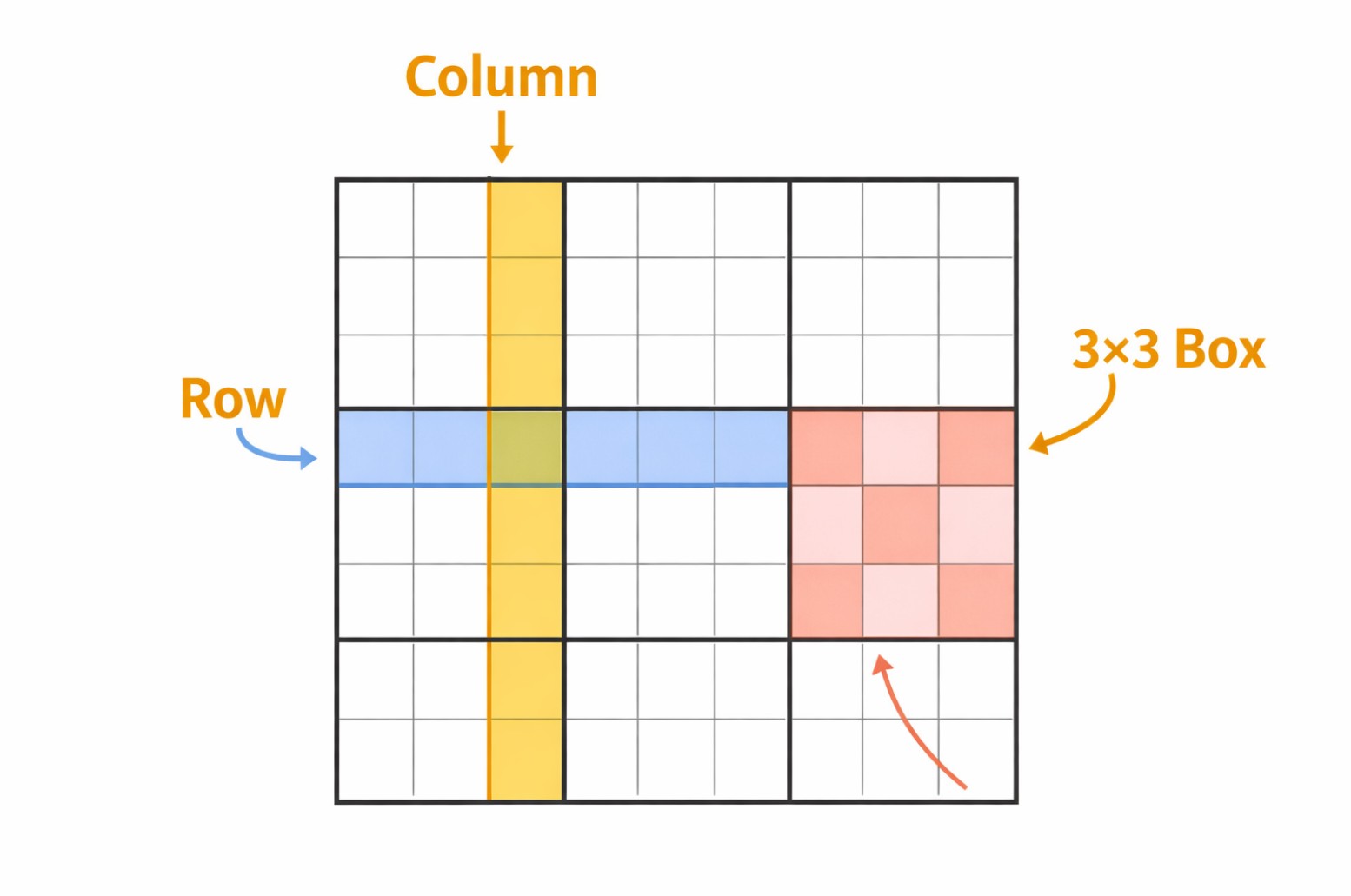
A standard Sudoku grid showing rows, columns, and 3×3 boxes.
Once you understand the structure of the Sudoku grid, the next step is learning the basic rules that control where numbers can be placed.
Basic Sudoku Rules
Sudoku follows a small set of rules that apply to every puzzle. Once you understand these rules, you already know how the game works. Every move you make must respect these three conditions at the same time.
Rule 1 — Rows
Every row must contain the numbers 1 through 9 exactly once. A number cannot appear twice in the same horizontal row.
Rule 2 — Columns
Every column must contain the numbers 1 through 9 exactly once. A number cannot repeat within the same vertical column.
Rule 3 — 3×3 Boxes
Each 3×3 box inside the grid must also contain the numbers 1 through 9 exactly once, without repeating any number.
These three rules work together. Whenever you place a number, it must be valid for the row, the column, and the box at the same time. If a number already appears in any of those areas, it cannot be placed in that cell.
Once beginners understand these basic rules, the next step is learning how to actually start solving a Sudoku puzzle and finding the first correct placements.
How to Start Solving a Sudoku Puzzle
Beginners often think Sudoku requires complicated techniques, but most puzzles start with very simple observations. By scanning the grid and looking for obvious placements, you can usually begin solving without guessing.
Step 1 — Scan the Grid
Look across rows, columns, and boxes to see which numbers are already present. The more numbers you notice in one area, the easier it becomes to identify the missing number.
Step 2 — Find Missing Numbers
If a row, column, or box already contains most of the numbers from 1 to 9, check which number is missing. Sometimes only one cell can logically contain it.
Step 3 — Eliminate Impossible Positions
Use the rules of rows, columns, and boxes to remove impossible positions for a number. If a number already appears in a row or column, it cannot appear there again.
Step 4 — Continue Step by Step
Each correct placement reveals more information about the puzzle. By repeating this process, the grid slowly becomes easier to solve.
Once you are comfortable starting a puzzle, the next stage of learning Sudoku is understanding simple solving strategies that help you find placements more efficiently.
Simple Sudoku Strategies for Beginners
Once you understand the rules and how to begin a puzzle, the next step in learning Sudoku is recognizing simple solving strategies. These techniques help players find correct placements faster by observing patterns inside the grid.
Beginners usually start with very basic logical strategies before moving to more advanced techniques used in harder puzzles.
Scanning
The scanning method involves checking rows, columns, and boxes to see where a number can logically fit based on existing placements.
Learn Sudoku StrategiesNaked Single
A naked single occurs when a cell has only one possible number that fits according to Sudoku rules. This is one of the most common beginner solving techniques.
Naked Single TechniqueAdvanced Pattern Example
More complex puzzles sometimes require advanced techniques such as pattern-based logic where candidate numbers interact across rows and columns.
X-Wing Sudoku TechniqueWhile strategies help solve more difficult puzzles, beginners improve fastest by combining simple techniques with regular puzzle practice.
Practice Sudoku While Learning
Reading about Sudoku is helpful, but real improvement comes from practice. Once you understand the rules, the grid, and the first solving steps, working through actual puzzles helps you apply that knowledge more naturally.
Many beginners make the fastest progress by starting with easier puzzles, repeating the same logical process, and gradually moving toward more challenging grids as their confidence grows.
Combining a clear beginner guide with regular puzzle practice is one of the best ways to become more comfortable with Sudoku. The rules teach the structure, but repeated solving turns that structure into real solving skill.