













What Are Word Search Puzzles and Why Are They So Popular?
A Word Search puzzle is a letter grid that contains hidden words placed in different directions. The goal is to find all the listed words by scanning the grid carefully and recognizing matching letter patterns. Words may appear horizontally, vertically, diagonally, forwards, backwards, or in a combination of directions depending on the puzzle difficulty.
Word Search puzzles are popular because they are simple to understand while still being flexible enough for many different uses. Children, students, teachers, parents, tutors, casual puzzle fans, and adult players can all use the same basic puzzle format in different ways depending on the vocabulary, layout, and difficulty settings.
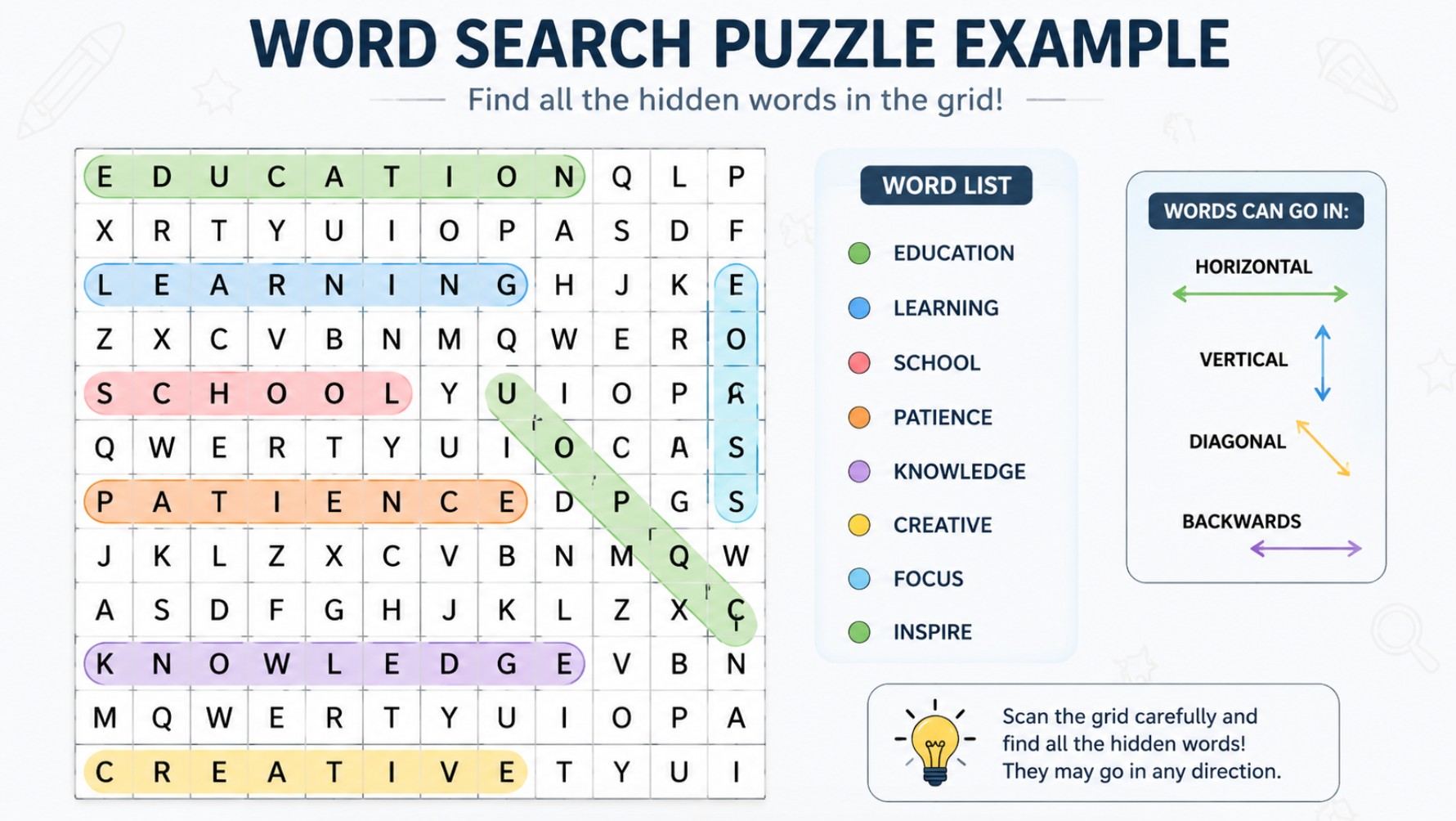
Word Search Puzzle Visual Example
This example demonstrates how Word Search puzzles work. Hidden vocabulary words are placed throughout the letter grid in multiple directions, while players scan the puzzle and match words from the provided vocabulary list.
Unlike many complex puzzle types, Word Searches usually require very little explanation before someone can begin solving them. Players only need to scan the grid, compare letters to the word list, and locate matching vocabulary inside the puzzle. This makes Word Searches accessible to a wide range of age groups and learning levels.
The format is also highly adaptable. A Word Search can be used as a classroom worksheet, a vocabulary review activity, a homeschool learning game, a holiday printable, a language-learning exercise, a tutoring activity, or a casual printable puzzle for entertainment.
Educational environments use Word Search puzzles frequently because they help reinforce vocabulary through repetition and visual recognition. Students scan the same words multiple times while solving the activity, which can improve familiarity with spelling patterns and key lesson terms.
Word Searches are also popular because they work well in both printable and digital formats. A puzzle may appear inside a worksheet packet, a classroom handout, a printable activity book, a homeschool lesson, a mobile game, or an online educational activity while still using the same core structure.
Another reason for their popularity is flexibility of difficulty. Small grids with simple horizontal words are often appropriate for younger children and beginner readers, while larger grids with diagonal and backwards words create more advanced challenges for older students and adults.
Word Search puzzles also support themed learning very well. Teachers and activity creators can build puzzles around science vocabulary, geography, history, spelling review, sports, holidays, literature, ESL practice, and many other educational or recreational topics.
Because the puzzle structure is simple but highly customizable, Word Searches remain one of the most widely used educational puzzle formats for classrooms, printable worksheets, tutoring activities, homeschool lessons, and casual puzzle entertainment.
Core Elements of a Word Search Puzzle
Letter Grid
The main puzzle area where hidden words are placed among random letters.
Word List
A collection of target words that players must locate inside the grid.
Hidden Words
Vocabulary terms placed in different directions throughout the puzzle layout.
Answer Key
An optional solution page showing where all hidden words are located.
Every Word Search puzzle is built from a few simple structural components. Even though the format looks straightforward, each element affects puzzle readability, difficulty, and educational usefulness.
The letter grid is the foundation of the puzzle. Grid size influences both difficulty and visual complexity. Smaller grids are easier for beginners, while larger grids support longer word lists and more advanced challenges.
The word list provides the vocabulary that players must find inside the puzzle. Educational Word Searches often use themed word lists connected to spelling practice, science lessons, geography topics, language learning, reading exercises, or classroom review activities.
Hidden words are placed throughout the grid according to the puzzle rules. Some puzzles use only horizontal and vertical placement for simplicity, while more advanced layouts include diagonal and backwards words to increase challenge and visual complexity.
Many printable Word Search puzzles also include an answer key. This makes the activity easier to use in classrooms, tutoring sessions, homeschooling, and worksheet review because teachers and students can quickly verify the correct word locations after solving the puzzle.
Together, these core elements create a puzzle structure that is flexible enough for entertainment, education, printable worksheets, vocabulary practice, and many different learning environments.
How Word Search Puzzles Work
| Step | How the Puzzle Is Built | Purpose |
|---|---|---|
| 1 | Choose a Word List | Select vocabulary related to a lesson, theme, topic, or activity |
| 2 | Place Hidden Words | Insert the words into the grid using different directions |
| 3 | Fill Empty Cells | Add random letters to complete the puzzle structure |
| 4 | Create the Final Layout | Organize the grid, word list, titles, and printable structure |
| 5 | Solve the Puzzle | Players scan the grid and locate the hidden vocabulary words |
Word Search puzzles work by combining vocabulary recognition with visual scanning. Players compare the listed words to the letter grid and search for matching sequences hidden inside the puzzle.
The creation process usually starts with a themed word list. Educational puzzles often use vocabulary connected to science, geography, spelling, language learning, history, holidays, or classroom review activities.
Once the words are selected, they are placed inside the grid according to the puzzle rules. Easier Word Searches may only use horizontal placement, while more advanced puzzles include vertical, diagonal, and backwards words to increase difficulty.
After the vocabulary is inserted, the remaining empty spaces are filled with random letters so the hidden words blend naturally into the puzzle. This creates the visual challenge that players must solve.
Solving a Word Search requires careful attention and pattern recognition. Players scan rows, columns, and diagonals while comparing letters to the target vocabulary list until every hidden word is located.
Although the puzzle structure is simple, small changes to the grid size, word placement, and allowed directions can significantly affect difficulty, readability, and overall puzzle experience.
Why Word Search Puzzles Help Learning
Word Search puzzles are widely used in education because they combine vocabulary review with active participation. Instead of only reading or memorizing words, students repeatedly scan, recognize, and interact with vocabulary inside the puzzle grid.
This repeated visual recognition helps reinforce spelling patterns and word familiarity. While searching for hidden vocabulary, learners repeatedly see the same letters and word structures, which can improve recognition and recall over time.
Word Searches also encourage concentration and attention to detail. Players must carefully scan rows, columns, and diagonals while comparing the grid to the target word list. This process supports focus, pattern recognition, and visual scanning skills.
Educational Word Searches are especially effective when the vocabulary is connected directly to a lesson or topic. Science terms, geography words, spelling lists, ESL vocabulary, reading exercises, and classroom review activities all become more engaging when presented in puzzle form.
Another advantage is accessibility. Word Search puzzles are relatively easy to understand compared to many other puzzle types, which makes them useful for younger students, beginner readers, mixed-level classrooms, and casual educational activities.
Printable Word Searches are also practical for classrooms because they are simple to distribute and complete. Teachers can use them as warm-up tasks, review activities, homework assignments, quiet-time exercises, or learning games without requiring special equipment or complicated instructions.
Many students also find puzzle-based activities less stressful than more traditional review methods. Because the learning process is combined with a game-like format, vocabulary practice can feel more relaxed and engaging.
For language learning and vocabulary development, repetition is extremely important. Word Search puzzles naturally encourage repeated exposure to key terms, which is one reason they remain popular in classrooms, homeschooling, tutoring sessions, and printable educational materials.
Educational Uses of Word Search Puzzles
- Classroom vocabulary review and spelling reinforcement activities
- Homeschool learning worksheets and printable lesson supplements
- ESL and language-learning vocabulary practice exercises
- Science, geography, history, and reading review activities
- Warm-up exercises and quiet classroom learning tasks
- Homework assignments and independent study activities
- Tutoring materials for reading, vocabulary, and spelling support
- Holiday and themed educational printables for children
- Library, camp, and club learning activities
- Printable educational games for mixed-age learning environments
Word Search puzzles are flexible educational tools because the same basic format can support many different subjects and learning situations. By simply changing the vocabulary list, teachers and activity creators can adapt the puzzle to almost any classroom topic or educational objective.
In classrooms, Word Searches are often used as review activities before tests, warm-up exercises at the beginning of lessons, or quiet independent tasks while students transition between subjects and activities.
Homeschool educators frequently use printable Word Searches because they are easy to prepare, easy to distribute, and flexible enough for different reading levels and lesson topics. The puzzles can also be reused throughout the year with different vocabulary themes.
Tutors and language-learning instructors often use Word Searches to reinforce spelling patterns and vocabulary recognition in a more engaging format than simple memorization exercises.
Because the puzzle structure is easy to understand, Word Searches work well for younger students and mixed-level groups while still remaining useful for older students and adults when larger grids and advanced vocabulary are used.
This combination of simplicity, flexibility, and educational usefulness is one of the main reasons Word Search puzzles remain widely used in printable worksheets, educational activities, tutoring sessions, and classroom learning.
What Makes a Word Search Puzzle Easy or Difficult?
Grid Size
Larger grids increase visual complexity and make hidden words harder to locate.
Word Length
Longer vocabulary terms are usually more difficult to scan and recognize.
Word Directions
Diagonal and backwards words create more advanced puzzle challenges.
Puzzle Density
Crowded grids with overlapping patterns are more difficult to solve visually.
Word Search difficulty is influenced by several design choices working together. Small changes to the grid structure, word placement, and puzzle layout can significantly change how easy or challenging the activity feels.
Smaller grids with short horizontal words are usually best for younger children and beginner readers because the vocabulary is easier to recognize quickly. Larger grids require more scanning and visual attention, especially when many words are hidden close together.
Word directions also affect puzzle complexity. Horizontal-only puzzles are generally easier because players scan in familiar reading patterns. Vertical, diagonal, and backwards placement require more careful searching and increase visual difficulty.
Puzzle density becomes important when many words are packed into a limited space. Dense layouts create stronger visual overlap between words, which can make scanning slower and more demanding for players.
Educational activities often adjust these factors depending on the audience. Simpler layouts may work best for beginner vocabulary practice, while larger and denser puzzles can create more advanced review activities for older students and adults.
Understanding these difficulty factors helps teachers, parents, and puzzle creators design Word Searches that match the reading level, attention span, and educational goals of the intended audience.
How to Choose Good Words for a Word Search Puzzle
Choosing the right vocabulary is one of the most important parts of creating an effective Word Search puzzle. Even a well-designed grid may feel confusing or unbalanced if the word list does not match the intended audience or topic.
Good Word Search vocabulary usually follows a clear theme or educational goal. Science terms, geography words, spelling lists, reading vocabulary, holiday themes, sports topics, and language-learning exercises all work well because the words are connected by a common subject.
The word list should also match the difficulty level of the puzzle. Younger children and beginner readers usually benefit from shorter and more familiar vocabulary, while older students and adults can handle longer terms and more advanced subject-specific language.
| Word Selection Tip | Why It Helps |
|---|---|
| Use a Clear Theme | Makes the puzzle feel more organized and educational |
| Balance Word Lengths | Improves readability and puzzle structure |
| Match the Audience Level | Keeps the activity appropriate for the intended players |
| Avoid Too Many Similar Words | Reduces visual confusion during solving |
| Use Relevant Vocabulary | Strengthens educational and thematic value |
Balanced vocabulary also improves puzzle readability. Extremely long words inside small grids can create crowded layouts, while very short words may make the activity feel too easy for advanced players.
Educational Word Searches are usually more effective when the vocabulary directly supports the lesson or activity being studied. Repeated exposure to key terms helps improve familiarity, spelling recognition, and retention.
Thoughtful word selection helps Word Search puzzles feel more intentional, more engaging, and more useful for classrooms, tutoring sessions, homeschool lessons, printable worksheets, and themed learning activities.
Common Word Directions Used in Word Search Puzzles
| Direction Type | Description | Difficulty Impact |
|---|---|---|
| Horizontal | Words appear left-to-right across rows | Usually the easiest direction to recognize |
| Vertical | Words appear top-to-bottom within columns | Moderate difficulty for most players |
| Diagonal | Words move diagonally across the grid | Increases scanning complexity and challenge |
| Backwards | Words appear in reverse letter order | Creates stronger visual difficulty |
| Mixed Directions | Multiple direction types are combined together | Produces the most advanced puzzle layouts |
Word directions are one of the main factors that influence puzzle difficulty. Simpler Word Searches often use only horizontal placement, while advanced puzzles combine multiple directions to create more challenging layouts.
Horizontal placement is usually the easiest because it follows normal reading patterns. Younger children and beginner readers often solve horizontal Word Searches more comfortably than puzzles with mixed directions.
Vertical and diagonal words require more careful scanning because players must search beyond traditional reading movement. This increases visual complexity and makes hidden vocabulary harder to recognize quickly.
Backwards words create another layer of challenge because players must identify reversed letter patterns while searching the puzzle grid. Mixed-direction puzzles combine several placement styles to create more advanced solving experiences for older students and adults.
Educational Word Searches often adjust directions depending on the lesson goal and audience. Simpler layouts may support vocabulary introduction and beginner practice, while advanced direction combinations work better for review activities and stronger puzzle challenges.
Understanding word directions helps teachers, parents, and puzzle creators design activities that balance readability, challenge, and educational value for different learning levels and puzzle-solving experiences.
Printable and Digital Word Search Activities
Word Search puzzles are widely used in both printable and digital formats. The same basic puzzle structure can work as a classroom worksheet, an online educational activity, a printable review page, a mobile puzzle game, or a homeschool learning exercise depending on how the activity is delivered.
Printable Word Searches remain especially popular in classrooms and educational settings because they are easy to distribute, simple to complete without devices, and practical for homework, review activities, and worksheet packets.
- Printable worksheets for classrooms, tutoring, and homeschool lessons
- Educational review pages for vocabulary and spelling practice
- Digital puzzles for browser-based and online learning activities
- Mobile-friendly Word Search games and educational apps
- Holiday and themed printable activity pages for children
- Online puzzle activities used in remote learning environments
- Printable puzzle books and educational worksheet collections
- Interactive vocabulary review activities for students and learners
Printable activities are useful because they support screen-free learning and physical interaction with the puzzle. Students can circle words manually, complete worksheets inside notebooks, and participate in classroom activities without relying on computers or tablets.
Digital Word Searches provide different advantages. Online puzzles are easier to share quickly, update dynamically, and integrate into remote learning and browser-based educational workflows.
Many educational systems now combine both approaches. Teachers and activity creators may design puzzles digitally and then export printable versions for classroom use, homework, tutoring, and worksheet distribution.
Because Word Search puzzles adapt well to both formats, they remain one of the most flexible educational puzzle types for printable learning activities, digital lessons, and recreational puzzle-solving.
How Teachers and Educators Use Word Search Puzzles
Teachers and educators use Word Search puzzles because they provide a simple and flexible way to reinforce vocabulary while keeping students engaged in a structured activity. The puzzle format works well across many subjects and age groups because the vocabulary can be customized for different lessons and educational goals.
In classrooms, Word Searches are often used as warm-up activities before a lesson begins. Students can review important terms while transitioning into the subject, helping activate vocabulary recognition before more detailed instruction starts.
Many teachers also use printable Word Searches as review exercises before quizzes and tests. Science terms, geography vocabulary, reading lists, spelling words, and language-learning exercises can all be reinforced through repeated visual exposure inside the puzzle grid.
Word Search worksheets are especially practical because they are easy to print, distribute, and complete independently. Students usually understand the rules quickly, which allows the activity to begin without long setup or complicated instructions.
| Educational Use | How Word Searches Help |
|---|---|
| Lesson Warm-Ups | Helps students transition into the topic and review key terms |
| Vocabulary Review | Reinforces spelling and word recognition through repetition |
| Homework Activities | Provides lightweight independent practice outside the classroom |
| Quiet Learning Tasks | Supports focused classroom activity with minimal supervision |
| Mixed-Level Learning | Difficulty can be adjusted for different student groups |
Homeschool educators and tutors also rely on Word Searches because they can be adapted quickly for different reading levels and educational topics. Smaller grids and simpler directions support beginners, while larger layouts create more advanced challenges for older learners.
Another advantage is flexibility. The same puzzle format can support science, geography, history, spelling, ESL vocabulary, reading activities, seasonal themes, and many other educational subjects without changing the overall worksheet structure.
Because Word Search puzzles combine learning with a game-like activity, educators continue to use them as practical tools for classroom engagement, vocabulary reinforcement, printable worksheets, and independent study.
How Word Search Puzzle Difficulty Changes
Easy Puzzles
Small grids, short words, and simple horizontal placement for beginners.
Medium Difficulty
Balanced layouts with vertical and diagonal words for mixed-age learners.
Hard Puzzles
Larger grids, denser layouts, and mixed directions increase complexity.
Advanced Challenges
Long vocabulary lists and complex visual scanning patterns for experts.
Word Search difficulty changes depending on how the puzzle is designed. Grid size, word placement, vocabulary complexity, and allowed directions all influence how challenging the activity feels for the player.
Easy Word Searches usually focus on readability and simple recognition. Younger children and beginner readers often benefit from smaller grids, shorter vocabulary, and horizontal-only word placement.
Medium-difficulty puzzles introduce more visual scanning by adding vertical and diagonal directions. These layouts create stronger vocabulary challenges while still remaining manageable for most classroom and educational use.
Hard Word Searches typically use larger grids with denser layouts and mixed directions. Players must scan more carefully because hidden words overlap visually and appear in less predictable locations.
Advanced puzzle layouts may also use longer vocabulary lists, subject-specific terminology, backwards words, and crowded grids that require more patience, concentration, and pattern recognition to solve successfully.
Understanding difficulty levels helps teachers, parents, puzzle creators, and educators choose layouts that match the reading ability, attention span, and educational goals of the intended audience.
Word Search Puzzle Design Tips
Good Word Search design is not only about hiding words inside a grid. A well- designed puzzle should also feel readable, balanced, and appropriate for the intended audience. Layout structure, spacing, vocabulary selection, and difficulty settings all influence how enjoyable and useful the activity becomes.
Readability is especially important for printable worksheets and educational activities. If the letters are too small, the puzzle is overcrowded, or the vocabulary is poorly organized, players may become frustrated before they finish the activity.
| Design Tip | Why It Matters |
|---|---|
| Use Clear Vocabulary Themes | Helps the puzzle feel more organized and educational |
| Balance the Grid Size | Improves readability and puzzle difficulty control |
| Avoid Overcrowded Layouts | Prevents visual confusion while solving the puzzle |
| Match Difficulty to the Audience | Keeps the activity appropriate for different learning levels |
| Preview Printable Layouts | Helps ensure clean spacing and organized worksheet structure |
Vocabulary balance is also important. Extremely long words inside small grids may create unreadable layouts, while very short and repetitive vocabulary may make the puzzle too easy for advanced players.
Educational Word Searches often work best when the vocabulary directly supports the lesson or activity being taught. Science terms, spelling lists, geography topics, reading exercises, and ESL vocabulary become more effective when the puzzle reinforces meaningful educational content.
Printable layouts should also be tested carefully before distribution. A grid that looks acceptable on screen may become crowded or difficult to read once printed for classroom or worksheet use.
Thoughtful puzzle design improves both educational value and solving experience. Clean layouts, balanced difficulty, and organized vocabulary help Word Search activities feel more professional, more engaging, and easier to use in real learning environments.
Frequently Asked Questions About Word Search Puzzles
| What is a Word Search puzzle? | A Word Search puzzle is a grid of letters containing hidden words that players must locate using a provided word list. |
|---|---|
| How do Word Search puzzles work? | Hidden words are placed inside a letter grid, and players search for matching vocabulary in different directions. |
| What are Word Search puzzles used for? | They are used for education, vocabulary practice, printable worksheets, and recreational puzzle-solving. |
| Why are Word Search puzzles popular in classrooms? | Teachers use them because they combine learning, vocabulary review, and simple classroom engagement. |
| Can Word Searches help with spelling practice? | Yes. Repeated visual recognition helps reinforce spelling patterns and vocabulary familiarity. |
| What makes a Word Search difficult? | Larger grids, longer words, dense layouts, and mixed directions increase puzzle difficulty. |
| What directions can hidden words use? | Words may appear horizontally, vertically, diagonally, forwards, backwards, or mixed. |
| Are Word Search puzzles useful for language learning? | Yes. ESL and language-learning activities often use Word Searches for vocabulary reinforcement. |
| Can Word Searches be printed? | Yes. Printable Word Search worksheets are widely used in classrooms, homeschooling, and tutoring. |
| Are Word Searches suitable for adults? | Yes. Larger grids and advanced vocabulary can create challenging puzzles for older students and adults. |
| How are Word Search puzzles created? | Puzzle creators select vocabulary, place words in a grid, and fill empty spaces with random letters. |
| Why do Word Searches work well for learning? | They combine repetition, visual scanning, and active vocabulary interaction inside a game-like activity. |
Word Search puzzles remain one of the most flexible educational puzzle types because they combine simple rules with customizable vocabulary and adjustable difficulty levels.
The same puzzle format can support classrooms, homeschool activities, vocabulary review, printable worksheets, tutoring sessions, and casual recreational puzzle-solving across many different age groups.
Understanding how Word Search puzzles work helps educators, parents, puzzle creators, and learners design better activities with stronger readability, more balanced difficulty, and clearer educational purpose.
From Learning About Word Searches to Creating Your Own Puzzles
Understanding how Word Search puzzles work makes it much easier to create better activities later. Once you know how grid size, word directions, vocabulary selection, spacing, and puzzle density affect difficulty and readability, you can design puzzles that feel more balanced and more useful for different audiences.
Many users begin by learning the basic structure of Word Search puzzles and then move toward creating their own worksheets and activities. Educational vocabulary, spelling review terms, science topics, geography lessons, holiday themes, and language-learning exercises can all be turned into custom Word Search activities once the puzzle principles are understood.
Printable and digital workflows also become easier to manage after learning the fundamentals of puzzle design. Teachers, parents, tutors, homeschool educators, and activity creators can choose layouts, difficulty levels, and vocabulary structures that better match their educational goals.
Word Search creation tools make this process faster by automatically building the puzzle grid while still allowing users to customize word lists, grid sizes, directions, printable layouts, and optional answer keys.
More advanced builder workflows provide additional refinement options for users who want stronger control over puzzle structure, readability, printable formatting, and overall worksheet presentation.
Whether the goal is a classroom worksheet, a vocabulary review activity, a printable learning game, a themed puzzle page, or a larger educational project, understanding Word Search fundamentals helps create activities that are more readable, more engaging, and more effective for learning.
As you continue exploring Word Search creation, you can move from simple puzzle concepts to more advanced workflows including printable worksheet design, custom puzzle builders, themed activity packs, and multi-page puzzle projects for educational or recreational use.