


Colour-dot number practice: understand what the screen can and cannot tell you
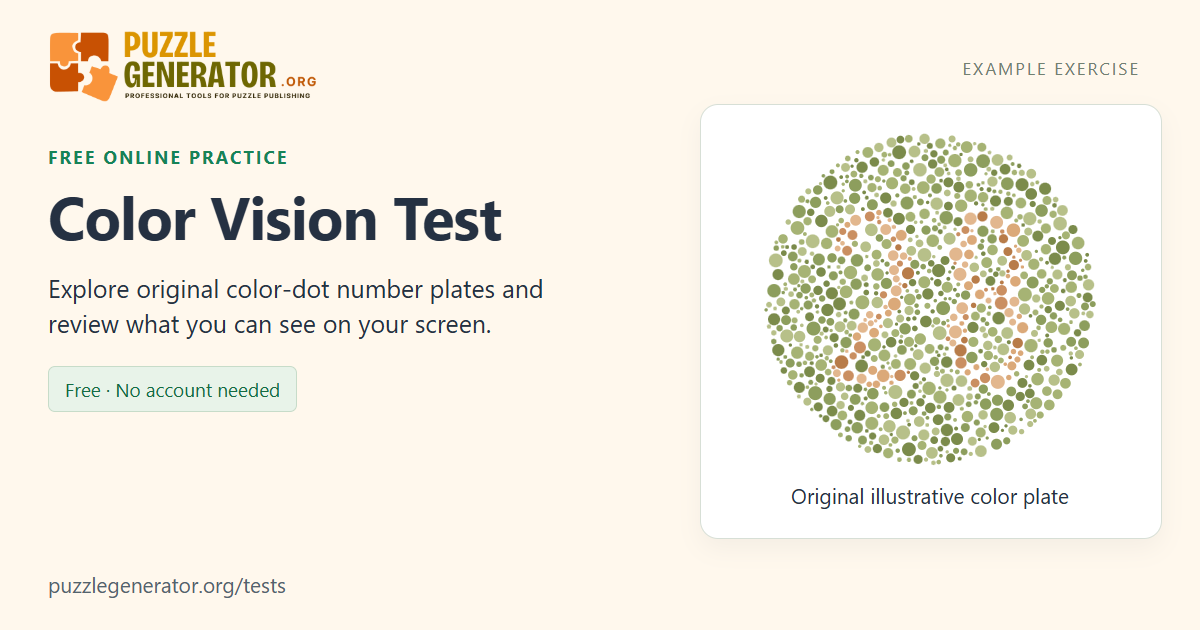
Before interpreting the ten plates, learn how this original illustration-based exercise differs from a clinical colour vision test and how viewing conditions can affect what you see.
By PuzzleGenerator.org · Updated
| Plates | 10 original illustrations: 2 controls and 8 colour-based plates |
|---|---|
| Response | Select a number button or choose Nothing |
| Timing | No countdown; take the time you need to view each plate |
| Result | Matches by colour combination, not a diagnosis or pass/fail |
How to use the colour-dot practice plates
Use normal room lighting and view the screen straight on at a comfortable distance. Turn off night mode, blue-light filters and color-changing screen modes; use your usual vision correction and do not use tinted glasses. Keep the plate comfortably visible without zooming excessively. Click or tap one of nine number buttons, or choose Nothing if you cannot see a number. Your selection takes you to the next plate automatically. Each plate appears once, with no correctness feedback until the end. There is no time limit.
How the plate matches are reported
The result reports matches with the intended figures, separately for two high-contrast controls and eight color-based plates. A second table groups your answers by the actual color combinations: orange/brown on olive, pink on green, and brown/beige on yellow-green. It shows the number of matches and Nothing responses for each group. Review all ten responses and intended numbers below. These counts describe recognition of these examples, not a pass/fail result, a deficiency percentage or a diagnosis of protan, deutan or tritan vision. The set does not establish individual red/green sensitivity or test blue-yellow deficiency. A missed control plate makes this screen-based run harder to interpret; even matching every plate cannot rule out a color vision difference.
These procedurally generated illustrations are original and have not been clinically validated. They are not the standard Ishihara test and cannot replace testing by an eye-care professional. If you or your child has difficulty distinguishing colors, professional testing is the appropriate next step. No health profile or account is created; completed practice summaries stay in your browser.
Is this an Ishihara test or a diagnosis of colour blindness?
No. This page provides original colour-dot illustrations for an informal number-recognition exercise. They are not standard Ishihara plates and have not been clinically validated. A pattern of matched or unmatched numbers on these illustrations cannot establish, exclude or classify a colour vision deficiency. The familiar appearance of dots containing a number does not make a newly drawn plate an approved clinical test.
If your aim is to find out whether you have a colour vision deficiency, an eye-care professional can advise on suitable testing and interpretation. Clinical testing uses specific methods and conditions; a browser illustration does not replace that process. This page is useful for exploring what you notice on a particular screen and understanding why online colour tasks need careful interpretation.
Why display settings and viewing conditions matter
A displayed colour depends on the device and its settings. Night mode, colour filters, brightness, display calibration, viewing angle and surrounding lighting can change the appearance of a plate. Tinted glasses can change it too. Follow the setup instructions before beginning and keep your screen at a comfortable position. Even careful setup does not turn these illustrations into a calibrated clinical instrument.
Select the number you can actually distinguish rather than adjusting the screen repeatedly until a guessed answer appears. There are nine number buttons for each plate, with a separate Nothing button if no number is visible. A choice takes you to the next plate automatically, without revealing whether it matched. A number that is difficult to read may reflect the illustration, digit recognition or the display conditions. The score alone cannot determine which explanation applies.
Why the result separates control plates from colour-based plates
The ten-plate run begins with two high-contrast controls and includes eight colour-based illustrations. The controls offer a basic check that you can recognise the displayed figures and select a response. They are not a separate diagnosis. If a control is not matched, reading the figures or the viewing setup may have affected the run, so the final page draws attention to that limitation.
The result also groups your answers by the combinations actually shown: orange/brown on olive, pink on green, and brown/beige on yellow-green. Each row gives the number of matches and Nothing answers in that group. It describes recognition of these examples rather than proving that either named colour is perceived normally. Matching all the intended numbers is not proof of unaffected colour vision; missing some is not proof of a deficiency. The separate coverage table explicitly marks red–green vision as not established and blue–yellow vision as not tested by this set.
How to use the exercise with a child or repeat it later
When helping a child, explain how to select a number and let them answer without pointing out a hidden figure. Check that they can read the digits and understand the controls. Avoid describing a missed illustration as a medical result. If colour recognition is causing practical difficulties or you have a concern about vision, seek advice about appropriate assessment rather than trying to settle it through repeated online attempts.
The plates in this exercise are fixed. Once you have seen the answer review, a repeat attempt can be influenced by remembering the intended numbers. A higher match count may therefore reflect memory rather than a change in colour perception. Recent summaries stay only in this browser. Records from the earlier plate design are labelled separately because the figures and answer controls have changed. The review explains the illustrations rather than issuing a clinical report.
How to interpret the result table
Read each part as a description of this exercise, keeping the controls and colour-based illustrations separate.
| Result entry | What it says | What it does not establish |
|---|---|---|
| Control-plate matches | Whether the two high-contrast intended numbers were selected. | A diagnosis or a complete check of eyesight. |
| Colour-plate matches | How many of eight intended numbers matched your responses. | Normal colour vision or a type or severity of deficiency. |
| Nothing | You did not report a number on that illustration. | The reason the number was difficult to distinguish. |
There is no clinical cutoff or pass/fail threshold for these original illustrations. Discuss vision concerns with an eye-care professional.
Frequently asked questions
Is this the official Ishihara colour blindness test?
No. These are original illustrative colour-dot plates, not standard Ishihara plates or a clinically validated substitute. They let you explore number recognition on your screen, without diagnosing or ruling out a colour vision deficiency.
What does matching every number mean?
It means your responses matched the intended numbers on these illustrations under your current viewing conditions. It does not prove that your colour vision is unaffected. The exercise has no validated diagnostic cutoff, and its score is not a clinical pass or fail.
What should I do when I cannot see a number?
Choose Nothing instead of guessing. The separate button appears below the nine number options and moves you to the next plate. The final review will compare your response with the intended figure. Difficulty with a plate can have several explanations, including the illustration and screen conditions; the result does not identify the cause.
Can I use these plates to test my child?
You can show the illustrations as an informal exercise if the child understands the instructions and can read the digits. Do not interpret a low match count as a diagnosis or give hints to produce a higher score. An eye-care professional can advise on suitable testing if you have concerns about a child’s colour recognition.
Can this result be used for a driving licence or job medical?
No. It is not a clinical report, an occupational assessment or proof that you meet a licensing requirement. Use the testing method and qualified professional required by the relevant authority or employer.
Sources and further reading
The instructions and scoring above describe this implementation. These references provide background; they do not validate or endorse this particular browser test.