


Logical reasoning practice: find a rule and check what follows
Learn how this twelve-question quiz combines number patterns, deduction, ordering and conditions, and use the explanations to understand the steps behind each answer.
By PuzzleGenerator.org · Updated
| Questions | 12, selected from 24 original questions |
|---|---|
| Categories | Number patterns, deduction, ordering, rules and conditions |
| Timing | Untimed; revisit or skip questions before finishing |
| Result | Total score, four category scores and explained answers |
How to take the logical reasoning test
Work through 12 original multiple-choice questions: three each on number patterns, deduction, ordering, and rules or conditions. Each attempt draws a balanced selection from a bank of 24 questions. Select one answer per question. You can go back to change an answer, or skip a question. Finish to see the solutions and explanations.
How the twelve-question score is calculated
Each correct answer earns one point. Incorrect and skipped answers earn zero, with no negative marking. Your result shows the total out of 12, the percentage correct, and your score in each category. All questions have the same weight; there is no time bonus.
This test is untimed. Switching tabs keeps your current attempt open. Reloading or leaving the page loses an unfinished attempt. Only completed scores are stored in your browser; the full answer review remains available until you restart or leave. This is reasoning practice, not a validated IQ assessment.
What do logical reasoning questions ask you to do?
Logical reasoning starts with information and asks what you can conclude from it. In one question, that information may be a sequence of numbers. In another, it may be a set of statements about an order or a rule that applies only when a condition is met. The challenge is to keep the supplied information separate from assumptions that merely sound plausible.
This quiz gives you three questions in each of four categories. The balanced selection lets you practise several kinds of reasoning in one sitting, while the category table shows which kinds of questions you answered correctly in that particular selection. It is an original practice activity. Twelve answers do not provide a standardised measure of general intelligence, a recruitment-test qualification or a population ranking.
A likely number pattern is different from a necessary conclusion
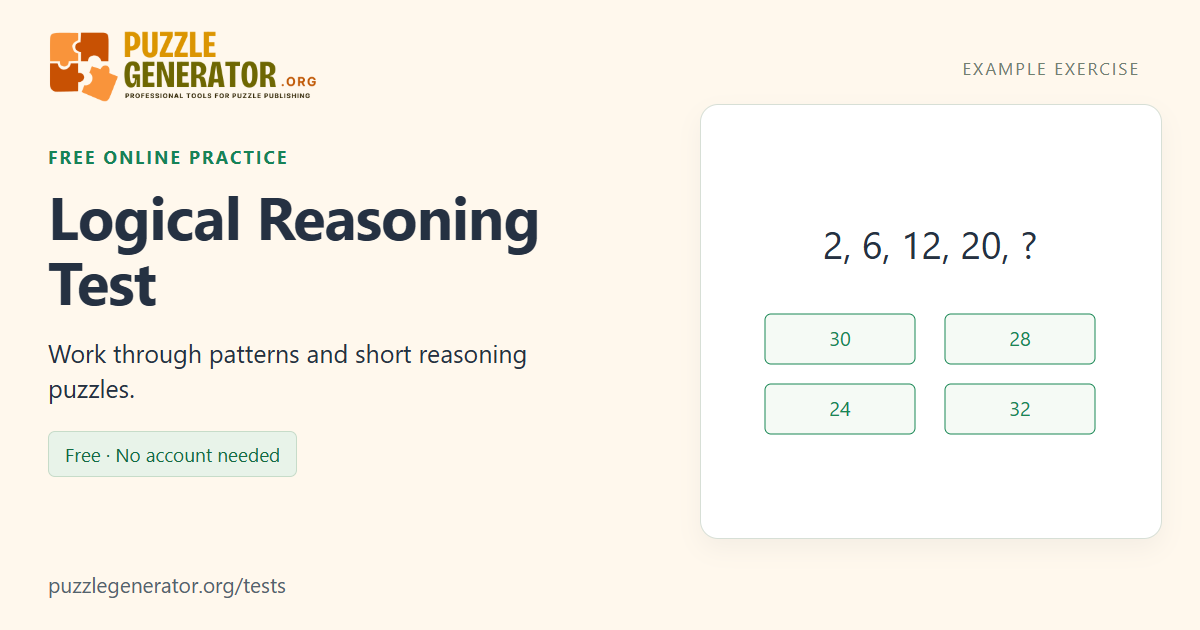
For a number pattern, compare neighbouring terms before choosing an option. Check differences, repeated multiplication, alternating steps or another rule supported by the displayed sequence. Then apply the same candidate rule to every transition you can check. A rule that explains only the last pair is weaker than one that fits the entire example. Short sequences can have many mathematical continuations; the task is to identify the intended consistent rule among the supplied options.
For deduction, ask whether an answer must follow from the statements rather than whether it could be true in everyday life. If all red tokens are square, that does not mean all square tokens are red. Try making a small counterexample: can the statements remain true while the proposed answer is false? If so, it is not a necessary conclusion. The final explanations help distinguish this kind of reasoning from spotting a numerical regularity.
Turn ordering clues and conditions into manageable steps
An ordering question becomes easier to inspect when you write the positions or relationships explicitly. Start with the most restrictive clue, then check the remaining clues against the proposed arrangement. Before selecting an answer, make sure it satisfies every condition rather than just the first one you used. A solution that places two items correctly can still violate a third relationship.
Conditional rules deserve the same care. Read words such as only, all, at least and exactly as part of the rule, not as decoration. Follow a chain in its stated direction and do not automatically reverse it. Because there is no countdown, you can pause, revisit a question and revise your answer before finishing. Skipping a difficult item can help you return with a clearer view of its conditions.
Use the review to practise reasoning, not just memorise answers
At the end, compare your chosen answer with the explanation and identify the step where they diverged. Did you overlook a transition, reverse an implication, add an unstated fact or miss a condition? That is a more useful practice note than simply recording that an item was wrong. Then explain the rule in your own words before looking at the correct option again.
Later attempts draw from the same twenty-four-question bank, so familiar questions will recur. A higher score can reflect learning the method, recognising an item or remembering its answer. Keep that context when comparing results. If you want a different kind of challenge, try the spatial diagrams or a printable logic-based puzzle rather than treating repeated scores on this small bank as evidence of a general change in ability.
Worked example: check the direction of a statement
Suppose every triangle in a box is blue, and one token in the box is a triangle. Consider what each claim actually permits.
| Claim | Does it follow? | Reason |
|---|---|---|
| That triangle is blue. | Yes | The rule covers every triangle in the box. |
| Every blue token is a triangle. | No | The rule does not exclude blue squares or other blue shapes. |
| A blue square is impossible. | No | The statement says nothing about the colour of squares. |
This is an instructional example, not a scored question or a population benchmark.
Frequently asked questions
Is this logical reasoning test timed?
No. There is no countdown or time bonus. You can read the conditions carefully, skip a question and revisit earlier answers before finishing. The score counts correct answers, not the speed at which you choose them.
Which logical reasoning question types are included?
Each run has twelve questions: three on number patterns, three on deduction, three on ordering and three on rules or conditions. They are selected from a bank of twenty-four original multiple-choice questions, with answer explanations available after finishing.
Do incorrect answers lose points?
No. Every correct answer earns one point; incorrect and skipped answers earn zero. All twelve questions have equal weight. The final result also separates the four category scores so you can see where the points came from.
Does this result give me an IQ score?
No. A score out of twelve is a practice result on these questions. It is not converted into an IQ, an age-based score or a population percentile. The quiz is not a validated intelligence assessment or an employment screening instrument.
Can I keep my answer review after leaving the page?
Completed score summaries are stored in this browser, with up to ten recent runs per test. The detailed answer review remains on the page until you restart or leave. Reloading the page loses unfinished answers; switching tabs during this untimed quiz keeps the current run open.
Sources and further reading
The instructions and scoring above describe this implementation. These references provide background; they do not validate or endorse this particular browser test.