


Verbal memory test: recognise words from the current run
Learn how New and Seen before are defined, why the two word categories are balanced, and how the review separates missed repeats from false alarms.
By PuzzleGenerator.org · Updated
| Format | 30 English word judgements |
|---|---|
| Word selection | 15 different words, each shown twice |
| Task | Choose New or Seen before within this run |
| Timing | No countdown or response-time bonus |
How to take the word-recognition test
Read each of 30 English words and decide whether it is New or Seen before in the current run. Select your answer and press Next. Each run selects 15 different words from a larger original word list, and each word appears exactly twice, with at least one other word between appearances. There is no time limit and no correctness feedback until the final review.
How the thirty word judgements are scored
Each correct New or Seen before judgement earns one point. The final tables show your score out of 30, accuracy, separate results for first appearances and repeated words, and every word with your answer and the correct choice. A new run resets the set of words you should recognise.
The words are in English, including on pages that currently use the English fallback. Language familiarity can affect your result. Hiding or leaving the page interrupts an unfinished attempt without saving it. This is word-recognition practice, not a vocabulary exam or a clinical memory test.
Recognising a word is different from recalling it unaided
In this test the word is visible when you answer. Your task is to decide whether it has already appeared in the session, rather than produce a missing word from a list. This is a recognition exercise. By contrast, remembering a number after it disappears asks you to recall its contents without seeing the answer again. Both involve memory, but the available cues and the required response differ.
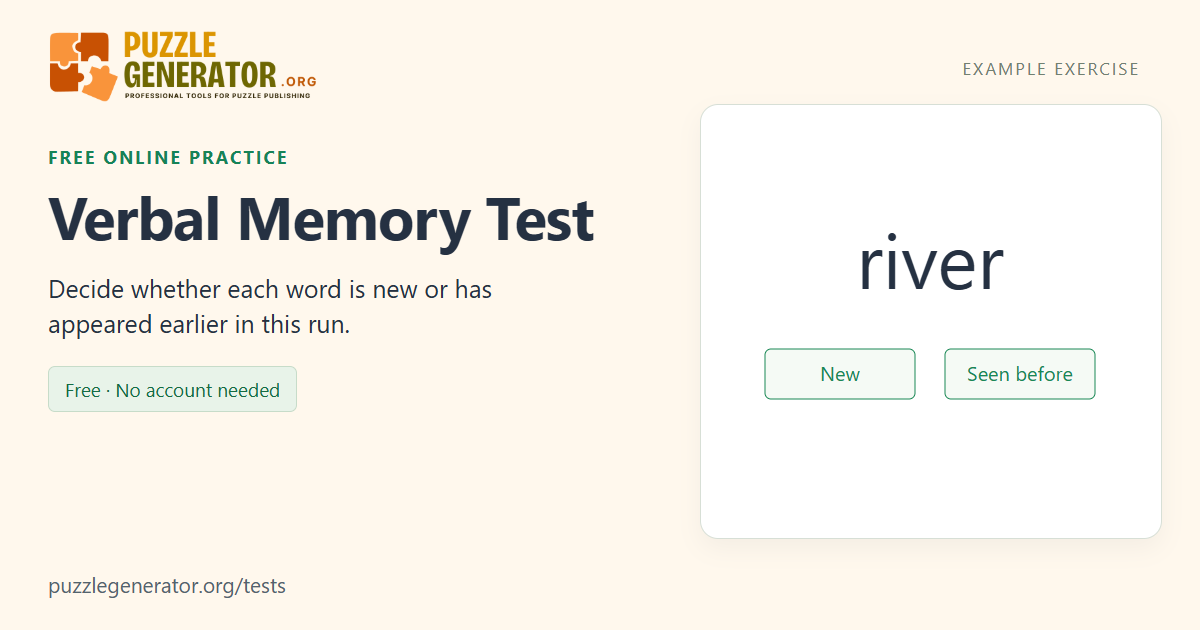
New does not mean that you have never encountered the word in everyday life. It means that this is its first appearance in the current run. A familiar word such as river can therefore require a New answer. Once that word has appeared in the session, its later occurrence requires Seen before. Starting another run resets this rule.
Why there are fifteen new and fifteen repeated words
Each run selects fifteen different words from the English word bank and shows each one twice. The order is shuffled, with at least one intervening word between a word’s two appearances. That produces fifteen first appearances and fifteen repeats. You do not have to type definitions, spell the words or memorise a list before the first question.
The balance matters when reading a total. Choosing New for every item would collect the first-appearance points but miss every repeated word. A score that contains points is therefore not, by itself, evidence that you distinguished both categories well. The final category table lets you check whether you correctly recognised repeats as well as correctly accepted words that had not yet appeared.
Distinguish a missed repeat from a false alarm
A missed repeat happens when a word has appeared before but you choose New. A false alarm happens when you choose Seen before on a word’s first appearance. The review shows the word, your judgement and the correct choice, so you can see which type of error occurred. There is no extra penalty for either error: every correct judgement earns one point out of thirty.
No correctness feedback appears between questions. This keeps a mistaken judgement from immediately telling you the word’s status for the rest of the run. You can take time to decide, because the exercise has no countdown, but moving to the next word submits that response. Earlier words are not displayed as a searchable list during the attempt.
Language familiarity and task familiarity both matter
The current word bank is English, including when the surrounding site uses an English fallback. Being comfortable reading the words can change how easily you recognise them. A lower result in an unfamiliar language is not a clean measure of memory. The exercise is also not a vocabulary examination: you are deciding whether a printed word appeared, not whether you can explain its meaning.
For a useful practice comparison, keep the language and conditions consistent and review the two category scores. You can try forming a brief mental image or noticing a word’s shape, but there is no required strategy or guaranteed improvement. Results stay on this device, and hiding the page interrupts an unfinished run. Use the record to follow your familiarity with this task, not to infer a diagnosis or a general verbal-ability rank.
Example: New refers to this session
Imagine that the first four displayed words are river, candle, river and bridge.
| Word | Earlier appearance in the run? | Correct choice |
|---|---|---|
| river, first occurrence | No | New |
| candle | No | New |
| river, second occurrence | Yes | Seen before |
| bridge | No | New |
Knowing all four words before the test does not change which response the session requires.
Frequently asked questions
Does New mean I do not know the meaning of the word?
No. It means the word has not appeared earlier in the current run. A word you know very well still requires New on its first appearance, and Seen before on its second appearance in that session.
How many repeated words are in a run?
There are fifteen repeats and fifteen first appearances. Each of the fifteen selected words appears exactly twice, with another word between those appearances. A new attempt selects and shuffles a word set again.
Is the verbal memory test timed?
There is no countdown and no response-time bonus. Read the word, select a judgement and press Next. You must complete the session without hiding the page; an interrupted or unfinished attempt is not added to recent results.
Is a score out of thirty a verbal IQ score?
No. It is the number of correct New or Seen before judgements in this word set. The test has no age norms, population percentiles or IQ conversion. English reading familiarity and experience with the task can affect the result.
Can I see which words I misclassified?
Yes. After all thirty responses, the review lists every word, your choice, the correct choice and the outcome. The browser saves the completed score summary in recent history, while the detailed word review remains available for the current visit.
Sources and further reading
The instructions and scoring above describe this implementation. These references provide background; they do not validate or endorse this particular browser test.