


Sequence memory test: remember locations and their order
A guide to the twelve ordered-recall rounds, repeated tile positions, exact-sequence scoring and useful ways to review a missed step.
By PuzzleGenerator.org · Updated
| Format | 12 rounds on a 3×3 grid |
|---|---|
| Sequence lengths | 2 to 7 steps, with two rounds at each length |
| Presentation | Each tile lights up for half a second |
| Controls | Click, tap or keys 1–9; undo and clear are available |
How to repeat the flashing tile sequences
Complete 12 rounds on a 3 × 3 grid. Watch each tile light up for half a second, then repeat the flashes in order. Sequences grow from two to seven steps, with two rounds at each length. Tiles can repeat, but never in two consecutive steps. Use the numbered tiles or keys 1–9, undo a step if needed, and press Next when your sequence is complete. There is no replay during a question.
How exact-sequence scoring works
An exact match, including the order of every tile, earns one point. All 12 questions are completed, regardless of mistakes. The final tables show your score, accuracy and both sequences for every round. Accuracy is based on complete sequences, not individual steps.
Switching tabs, hiding the page or ending the attempt interrupts it without saving a result. Complete each run in one sitting. This is an ordered-recall practice game, not a diagnostic memory assessment.
A sequence is more than a collection of locations
If three squares flash in turn, remembering which squares were involved is only part of the task. You also need to reproduce the order. A route from the top-left cell to the centre and then to the bottom-right cell is different from a route through the same cells in reverse. This distinction separates sequence memory from the Visual Memory Test, where a set of locations is recalled without an order requirement.
The grid stays at 3×3, so there are nine possible tile positions throughout the quiz. The challenge grows through the length of the sequence rather than through a changing board size. Each round uses a newly generated sequence. You should recall the flashes shown in that round, rather than expect the previous sequence to return with one more step added.
Read the numbered positions and allow for repeated tiles
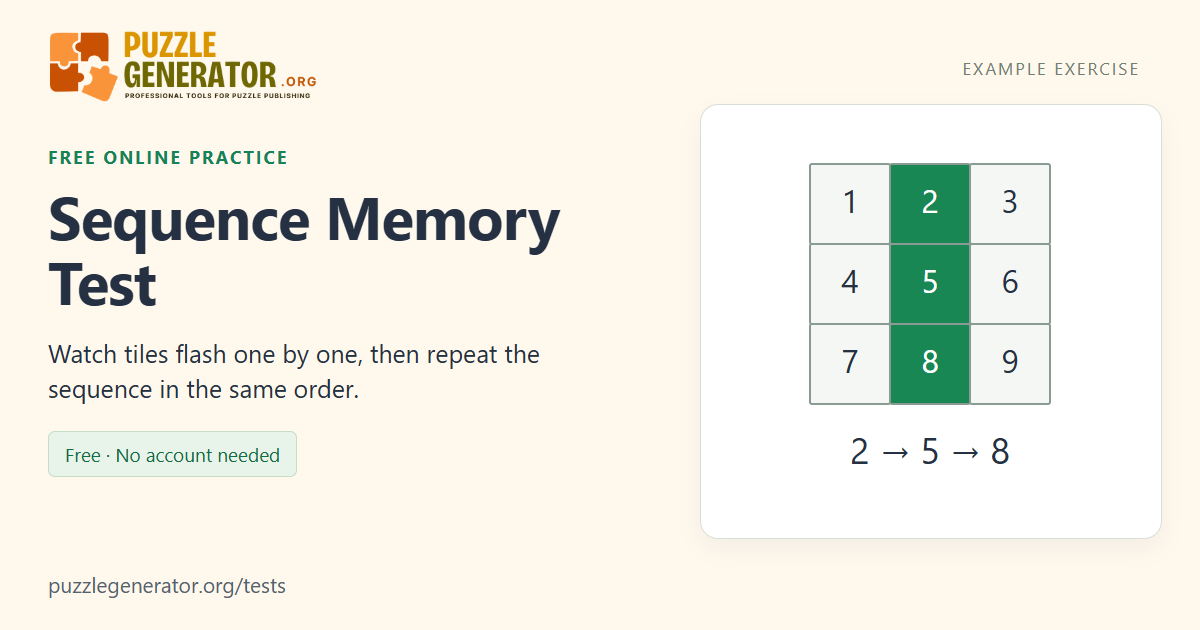
The tile numbers run left to right across the top row, then the middle row, then the bottom row. You can use these numbers as keyboard shortcuts or select the same positions directly with a pointer. The numbering also makes the answer review readable: an arrow between two numbers means that one location was followed by the other.
A position can appear more than once within a sequence, although two consecutive flashes never use the same tile. For example, 2 → 7 → 2 contains three steps, not two selected cells. When reproducing it, you must enter the return to tile 2. Counting only the different locations loses information that the exact-order comparison needs.
Use the first differing step to understand a missed round
Each complete match earns one point out of twelve. A correct beginning followed by a wrong final step does not earn partial points, but the review preserves the full shown and entered sequences. Compare them from the start and find where they first diverge. You may have swapped two adjacent positions, left out a return to an earlier tile, or shifted the remaining steps after one omission.
There are two rounds at every length from two to seven. A successful longer round and a missed shorter round can both occur; the quiz does not stop at the first mistake. That is another reason to inspect the individual rows instead of treating the final percentage as a single measured capacity or a boundary between normal and abnormal memory.
Try a route, a rhythm or a short verbal description
You can experiment with imagining a route across the board or quietly naming the tile positions. If you use a rhythm, make sure it helps you preserve repeated steps rather than merely the total number of flashes. The entered sequence remains visible before you press Next, so Undo last step and Clear sequence let you correct an input you did not intend.
Use similar conditions when comparing attempts. The half-second flashes and the fixed grid are part of this task, and a different sequence game may use a growing prefix, extra lives or a faster display. Hiding this page interrupts a run rather than replaying a missed presentation. Completed summaries stay in the browser, while the full ordered review belongs to the current visit.
Example: returning to the same tile
Suppose the sequence is 2 → 7 → 2.
| Sequence entered | What changed | Outcome |
|---|---|---|
| 2 → 7 → 2 | Every step is in the shown position | Exact match |
| 2 → 2 → 7 | The same positions appear in a different order | No point |
| 2 → 7 | The final return to tile 2 is missing | Incomplete sequence |
The position numbers are interface labels, not numbers you need to add or sort.
Frequently asked questions
How is sequence memory different from visual memory?
This test checks an ordered series of flashes on a fixed grid. The Visual Memory Test checks the locations in a briefly shown pattern and ignores selection order. You can use both as practice, but their scores describe different tasks and should not be compared as if they used the same scale.
Does each new sequence extend the previous one?
No. Every round has a new sequence. The length increases after two rounds, from two steps through to seven, but you must watch the current presentation rather than reuse the earlier order.
Can a tile appear twice in a sequence?
Yes. A tile can return later in the sequence, with another tile between its appearances. Reproduce each occurrence. Consecutive identical flashes are not generated, which avoids ambiguity about whether one continuous highlight represented one step or two.
Can I correct a click before pressing Next?
Yes. Undo last step removes the most recent entry, and Clear sequence removes all entries for the current round. You must enter the required number of steps before continuing. With keyboard input, Backspace also undoes the last step.
What is a good sequence memory score?
There is no population or age norm for these twelve original rounds. An 8/12 result means eight complete sequences matched exactly. Look at the sequence lengths and individual differences, then compare your own later runs under the same presentation and input conditions.
Sources and further reading
The instructions and scoring above describe this implementation. These references provide background; they do not validate or endorse this particular browser test.