


IQ-style practice questions: learn the reasoning behind the answer
Explore the five skills in this original twenty-question practice quiz, understand the category breakdown and use the explanations without turning a raw score into a made-up IQ.
By PuzzleGenerator.org · Updated
| Questions | 20, selected from 40 original questions |
|---|---|
| Balance | 4 questions in each of 5 reasoning categories |
| Access | Free; no registration, payment or countdown |
| Feedback | Raw score, skill breakdown and every answer explanation |
How to take the IQ practice test
Complete 20 original multiple-choice questions, four in each of five skill categories. Each run selects from a bank of 40 questions and shuffles the answer options. Some tasks use 4 × 4 diagrams; matrix questions combine panels across a row. Read the stated rule carefully, choose an answer, and use Next. You can revisit any earlier question before finishing, or skip a question. There is no countdown, and completion time does not affect the score.
What your practice score tells you
Each correct answer earns one point. Incorrect and skipped answers earn zero, with no negative marking. The result shows your total out of 20, percentage correct, skipped questions and four-question scores for each skill. Every question is reviewed with your response, the correct option and an explanation. We do not convert this score to an IQ, age equivalent, population rank or intelligence label.
This is an original practice quiz, not a standardised intelligence assessment. English fluency, familiarity with the tasks and earlier attempts can affect your result. Scores are not suitable for educational placement, diagnosis or employment decisions. Switching tabs keeps an untimed run open; reloading or leaving loses unfinished answers. Completed summaries are stored only in your browser.
An IQ practice quiz and a standardised IQ assessment serve different purposes
An IQ-style practice quiz gives you an opportunity to work through kinds of questions associated with reasoning tests. A standardised intelligence assessment needs more: defined administration, appropriate norms and evidence for the meaning of its scores. The percentage correct on an original set of questions does not supply that reference population. Converting it into an IQ would add information that this quiz does not have.
Here the result stays close to what actually happened. You receive the number of questions you answered correctly out of twenty, the percentage correct, skipped questions and scores for five skills. You also receive explanations without registering or paying to unlock a result. There is no numerical IQ estimate, intelligence label, age equivalent or population percentile hidden behind the final button.
What are the five reasoning skills in this quiz?
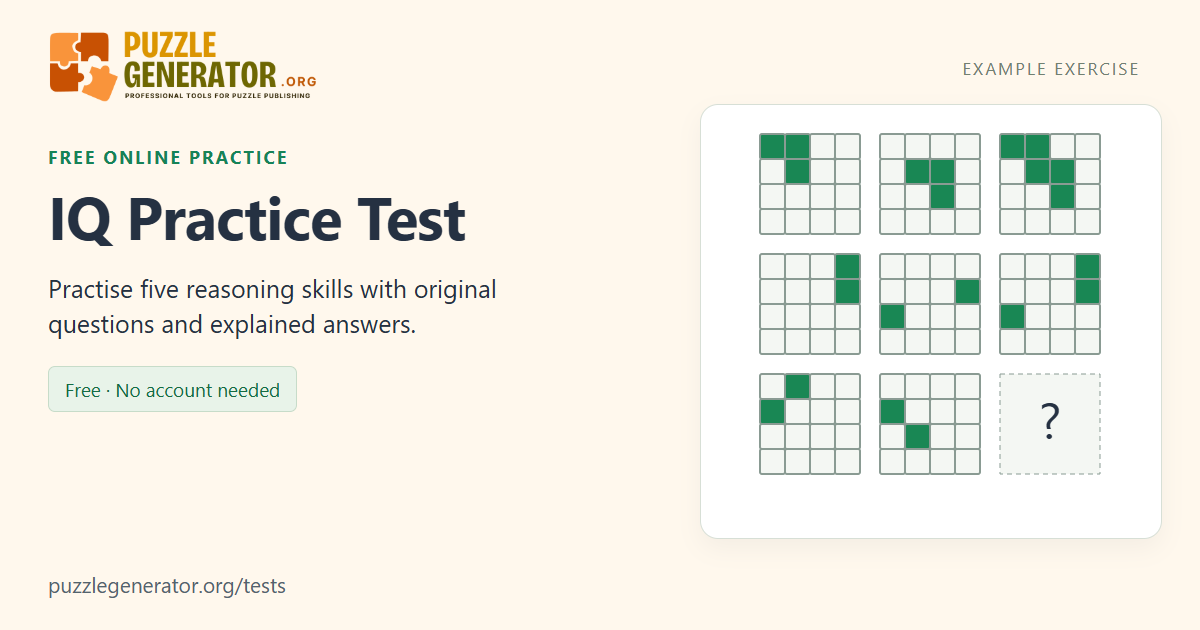
Visual matrices ask you to infer how panels relate across a matrix and complete the missing panel. Number series ask you to identify a consistent numerical relationship. Verbal analogies compare relationships between concepts, so the relationship matters more than whether two words are loosely associated. Each category contributes four questions to a balanced run.
Spatial transformations ask you to follow stated rotations or reflections of a diagram. Deduction asks what follows from explicit statements or conditions. These categories overlap in everyday problem solving, but their separate scores make the review easier to use. Four answers per category are a brief practice sample, not a reliable profile of a person or a complete account of intelligence.
A practical approach to unfamiliar reasoning questions
Begin by describing what changes and what stays the same. In a matrix, inspect one row or column at a time and test the proposed rule against the other completed panels. In a series, check every available transition. In an analogy, state the relationship in a short sentence and see whether the same sentence fits an option. Avoid choosing an answer only because one feature resembles the prompt.
For a transformation or deduction, follow the instructions literally and in order. Check whether the conclusion is required by the information, rather than merely possible. You can skip a question and come back, or revise an earlier response before finishing. There is no countdown or time bonus, so careful checking is part of the exercise rather than something the scoring discourages.
Use explained answers to guide your next practice session
The answer review shows what you selected, the correct response and the reasoning behind it. On a missed item, look for a specific cause: a reversed relationship, an overlooked cell, an arithmetic step or an assumption the question never supplied. Try applying the explanation to the prompt yourself. Understanding why a tempting option fails is often as useful as identifying the correct one.
A new run selects from the same forty-question bank, so repetitions are expected. Familiarity with the items, the English wording and the question formats can affect later results. Compare them as progress on this practice bank, without calling the difference an IQ gain. If one skill interests you, continue with the separate logic or spatial quiz, or choose a memory task for a different challenge.
Worked example: read a skill breakdown honestly
Imagine a completed practice run with the following category scores. These are illustrative values, not expected scores or norms.
| Skill | Correct / questions | Useful next step |
|---|---|---|
| Visual matrices | 3 / 4 | Review the rule in the missed panel. |
| Number series | 4 / 4 | Explain each series rule without looking at the options. |
| Verbal analogies | 2 / 4 | Compare the precise relationships between the words. |
| Spatial transformations | 3 / 4 | Check the order of the turn and reflection. |
| Deduction | 2 / 4 | Separate conclusions that must follow from ones that could be true. |
The total is 14 out of 20, or 70% correct on this example. It is not an IQ of 70, 114 or any other intelligence estimate.
Frequently asked questions
Will this IQ practice test give me a numerical IQ?
No. You receive a raw score out of twenty, accuracy, scores by skill and explanations. This original quiz has no standardised reference population, so the result is not converted into an IQ, an age equivalent or a population percentile.
Is the result free, or do I pay after answering?
The practice questions, final score, skill breakdown and answer explanations are all free. No account or payment is required to see them. Completed summaries are stored locally in your browser rather than added to an account.
How long do I have to answer the questions?
There is no countdown. Each run contains twenty questions, four in each of five categories, and you may revisit or skip items before finishing. The score rewards correct answers, with no time bonus and no penalty points for incorrect responses.
Are these questions copied from an official IQ test?
No. The quiz uses a bank of forty original practice questions. It is not an official version of a standardised intelligence assessment, and its scores cannot be treated as equivalent to scores from one.
Does improving my practice score mean my IQ increased?
That conclusion does not follow. Later scores can reflect familiarity with the questions, learning a rule or remembering an answer. Use the review to develop your approach to these tasks; the quiz does not measure an IQ change or provide diagnostic, educational-placement or employment decisions.
Sources and further reading
The instructions and scoring above describe this implementation. These references provide background; they do not validate or endorse this particular browser test.