


Spatial reasoning practice: follow shapes, transformations and routes
A guide to the two-dimensional diagrams in this quiz, with a practical way to distinguish rotations from reflections and check combined shapes without guessing.
By PuzzleGenerator.org · Updated
| Questions | 12, selected from 24 original questions |
|---|---|
| Diagrams | Two-dimensional patterns on 4 × 4 grids |
| Skills | Rotation, reflection, combining shapes and following routes |
| Result | Score out of 12, category breakdown and diagram review |
How to take the spatial reasoning test
Solve 12 original visual questions: three each on rotation, reflection, combining patterns, and moving across a grid. Each attempt draws from a bank of 24 questions. Compare the reference diagram with four answer diagrams and choose one. Every diagram uses a 4 × 4 grid, with rows counted from the top and columns from the left.
How the spatial practice score and review work
Each correct answer earns one point. Incorrect and skipped answers earn zero. Your result shows the total out of 12, the percentage correct, and separate scores for the four categories. The final review shows the reference, your answer, the correct diagram and the rule used to solve it.
There is no time limit. You can revisit questions before finishing. Switching tabs keeps the attempt open; reloading or leaving loses unfinished answers. These are 2D visual reasoning exercises, not a clinical or IQ assessment. Completed score summaries are stored only in your browser.
What kind of spatial reasoning does this quiz practise?
Spatial questions ask you to track where parts of a shape go when a rule changes its position or orientation. This quiz uses two-dimensional grids rather than three-dimensional cubes or folded paper. The reference pattern and answer options let you inspect individual cells, so you can test a transformation instead of relying only on an overall visual impression.
Each attempt contains three questions in each of four categories: rotation, reflection, combining shapes and routes. The selection comes from twenty-four original questions. The resulting score describes your answers to that selection; it is not a measure of every spatial skill, a professional aptitude certificate or an IQ. A person may find one transformation familiar and another unfamiliar without that difference defining a general ability.
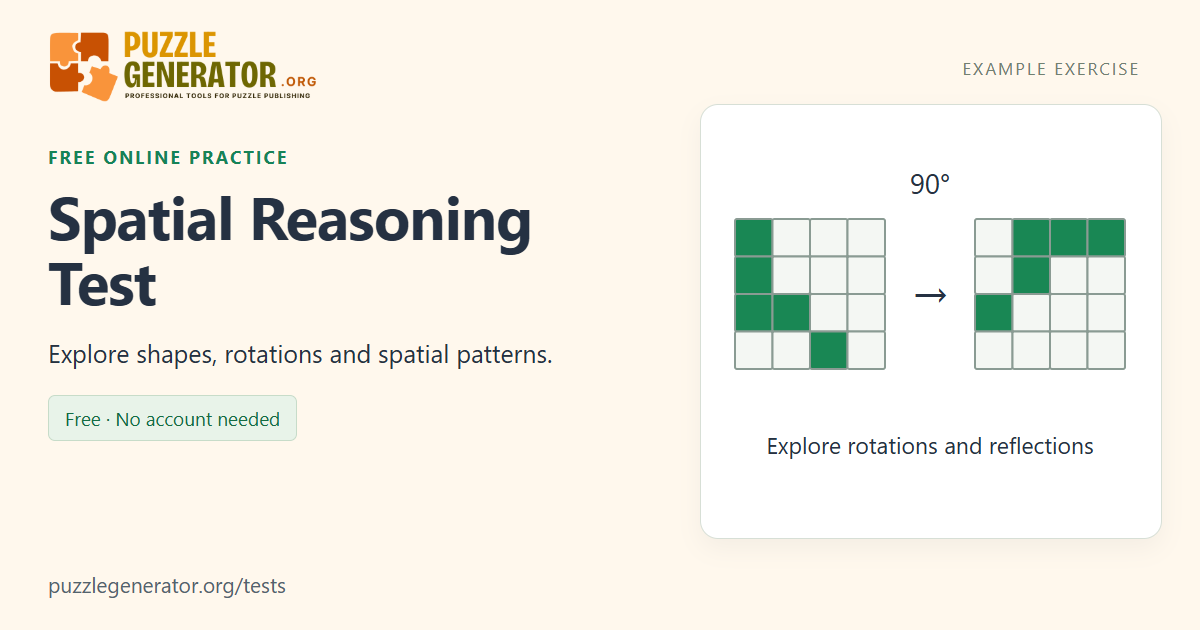
Distinguish a rotation from a reflection
A rotation turns a pattern around the centre. A reflection flips it across a line. They can look similar when a shape has symmetry, so start with an asymmetric feature: an isolated cell, a short arm or a corner that does not have a matching counterpart. Track where that feature must go under the stated operation. Then check the rest of the shape against the same rule.
Direction and order matter. A clockwise turn is different from an anticlockwise turn, and reflecting before rotating can differ from rotating before reflecting. Read the full instruction before comparing the options. When the quiz specifies several steps, apply them one at a time and preserve the intermediate arrangement mentally or on scratch paper. The untimed format gives you room to check a proposed result before moving on.
Check combinations cell by cell and routes step by step
When two shapes are combined, first identify the stated operation. A union keeps cells present in either pattern; an intersection keeps only shared cells; an exclusive-or keeps cells present in one pattern but removes shared cells. Comparing a few diagnostic cells can eliminate an option, but check the full arrangement before deciding. Similar outlines can hide one important difference inside the grid.
For route questions, establish the starting location and the direction of each move. Keep the grid boundaries in view and update your position after every instruction. If the final location seems wrong, retrace the moves from the start rather than adjusting only the last step. The review shows the correct diagram and the relevant rule, which makes a missed transformation or route easier to inspect.
Read category scores as feedback on these diagrams
Every correct response earns one point, regardless of the category or how long you spent on it. An incorrect or skipped item earns zero. Use the four category scores to locate questions worth reviewing, then compare your response with the displayed solution. With only three items per category, one answer changes that category score substantially; a single run is a small sample of performance.
Repeated attempts use the same bank. As you learn a transformation or recognise a diagram, your score may improve through familiarity. You can make the review more useful by describing the rule that maps the reference to the answer, rather than memorising an option position, since the answer options can change order. For a different task, try visual memory to recall a hidden pattern or a maze generator to explore paths on paper.
Worked example: follow one cell through a turn
Number the rows of a 4 × 4 grid from top to bottom and columns from left to right. Consider a marked cell at row 1, column 2.
| Operation about the grid centre | New location | Check |
|---|---|---|
| Rotate 90° clockwise | Row 2, column 4 | The top edge moves to the right edge. |
| Reflect across the vertical centre line | Row 1, column 3 | The row stays fixed; left and right swap. |
| Reflect across the horizontal centre line | Row 4, column 2 | The column stays fixed; top and bottom swap. |
This coordinate example explains the operations. The scored questions use diagrams and specify the transformation to apply.
Frequently asked questions
Does this spatial reasoning test include 3D cubes?
No. This implementation uses two-dimensional patterns on 4 × 4 grids. It covers rotations, reflections, combining shapes and following routes. It does not include three-dimensional cube rotation, paper folding or a full assessment of spatial ability.
How many questions are in one attempt?
There are twelve questions, with three in each of four categories. Each run selects from twenty-four original questions. You can revisit answers or skip a question before finishing, and there is no countdown.
How do I tell a reflected shape from a rotated one?
Follow an asymmetric feature such as an isolated cell or an unequal arm. A rotation moves it around the centre; a reflection flips it across the specified line. Apply the stated operation to the whole pattern and compare the resulting positions, rather than selecting a shape because it looks broadly similar.
Will the results show the correct diagrams?
Yes. After finishing, the review shows the reference, your answer, the correct diagram and an explanation of the rule. The total score is out of twelve, with separate category scores. There are no penalty points or speed bonuses.
Can I compare the score with a job aptitude test?
Not as an equivalent score. Employers and assessment providers use their own tasks, timing and scoring rules. This original untimed quiz supplies practice feedback only, without employment norms, a percentile or an IQ conversion.
Sources and further reading
The instructions and scoring above describe this implementation. These references provide background; they do not validate or endorse this particular browser test.