


Mental maths test: arithmetic practice with clear answer reviews
Choose a level and operation, understand the generated questions, and use accuracy, elapsed time and worked answers to review your own arithmetic practice.
By PuzzleGenerator.org · Updated
| Run length | 20 questions |
|---|---|
| Settings | 3 difficulties; mixed or a single operation |
| Answers | Whole numbers; no calculator needed |
| Timing | Elapsed time is reported, without a countdown or time bonus |
How to take the mental maths test
Choose Easy, Medium or Hard and either mixed operations or addition, subtraction, multiplication or division. Solve 20 questions mentally, enter whole-number answers and press Next. You can go back to revise an answer or skip a question. Mixed runs contain five questions per operation. Easy addition and subtraction use 1–20; Medium uses 10–99; Hard uses 100–999. Multiplication factors are 2–5, 2–12 or 6–20. Division uses those same factors in reverse, always with a whole-number answer.
How arithmetic answers, time and skipped questions are scored
Each correct answer earns one point. Incorrect and skipped answers earn zero. Review your score out of 20, accuracy, total elapsed time, results for each operation, and all questions with their correct answers. There is no time bonus or countdown. Time starts at the first question and ends when you finish; avoid a calculator if you want to compare mental-arithmetic attempts.
Compare runs with the same difficulty and operation settings. Hiding or leaving the page interrupts an unfinished run without saving it. Only completed summaries are stored in your browser. This is arithmetic practice, not an IQ assessment or a school-grade benchmark.
Calculate the answer rather than recognise a familiar pattern
This test asks you to carry out addition, subtraction, multiplication or division without a calculator. The number is not something you saw earlier and must recall verbatim, and you are not inferring the next item in a series. You are solving a stated calculation. That makes it a different activity from the Number Memory Test or the number-pattern questions in Logical Reasoning.
Choose a setting that suits the kind of practice you want. You can focus on one operation or choose a mixed set with five questions of each type. The exercise has no countdown, so you can work through an answer deliberately. Completion time is still recorded, but a faster time does not turn an incorrect response into a point.
What Easy, Medium and Hard change
The difficulty setting changes the operands, not the number of points available. Addition and subtraction use operands from 1–20 on Easy, 10–99 on Medium and 100–999 on Hard. Subtraction is generated without negative results. Multiplication uses factors from 2–5, 2–12 or 6–20, and division reverses a multiplication so that the answer is a whole number.
These settings are transparent task ranges, not school-year standards or age-based ability levels. A twenty-question Easy addition score and a twenty-question Hard mixed score describe different work. The history includes the selected settings so that you can compare similar runs instead of treating every percentage as though it came from the same set of questions.
Use the review to check a calculation method
For addition, you might split an operand into tens and units, or make a nearby round number and adjust. For multiplication and division, a known multiplication fact can help check a result. For subtraction, you can verify by adding the difference back to the smaller operand. These are approaches to explore; the page checks the final whole-number answer rather than requiring one particular written method.
The review lists the original expression, your response and the correct answer. If a mistake repeats, isolate that kind of calculation in a single-operation run. If the difficulty was mainly changing between operations, use the mixed setting to practise reading the sign before calculating. The category breakdown helps you choose a focus without claiming that four operation scores diagnose a learning difficulty.
Keep accuracy and completion time separate
The timer covers the run from the first question until you finish, including time spent revisiting answers. You can move back and revise a response before submission of the final test, or skip a question. There is no speed multiplier or hidden penalty for careful checking. The final score counts correct answers, while elapsed time is an additional description of how the session went.
Compare the same difficulty and operation settings, and keep your calculation method consistent if you are tracking mental arithmetic. Writing extensive notes or using a calculator changes the activity even though the input field still accepts the answer. Hiding the page interrupts an unfinished run, and only completed summaries enter the device’s recent history. A practice percentage is not an IQ or an externally validated school grade.
Example: break a calculation into checkable steps
These examples illustrate strategies rather than questions from your current generated run.
| Expression | One possible approach | Answer |
|---|---|---|
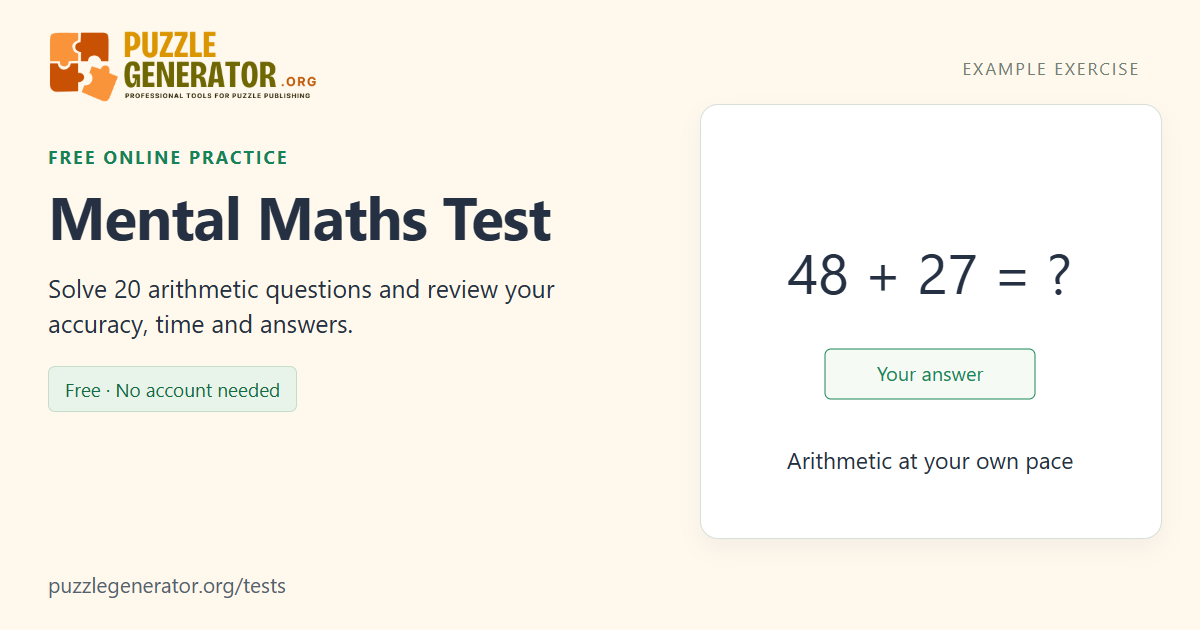
| 48 + 27 | 48 + 20 = 68; 68 + 7 = 75 | 75 |
| 84 ÷ 7 | Check the multiplication: 7 × 12 = 84 | 12 |
| 93 − 58 | 93 − 60 = 33; add back 2 | 35 |
The test checks the final whole number and does not require you to enter intermediate working.
Frequently asked questions
Is the mental maths test timed?
It records total elapsed time but has no countdown or time bonus. Work at your own pace, revise an answer if needed, and finish to see accuracy and time separately. Comparing speed is most useful when the difficulty and operation settings match.
Will division questions require decimals or fractions?
No. The generated division questions reverse multiplication facts from the chosen factor range, so the answer is a whole number. The answer field accepts whole-number responses rather than expressions, decimal notation or fractions.
How are mixed-operation questions distributed?
A mixed run contains five additions, five subtractions, five multiplications and five divisions, in a shuffled order. A single-operation run contains twenty questions of the selected type. Each correct answer has the same one-point value.
Can I go back to change an answer?
Yes. Before finishing, use Previous question to revisit earlier questions and revise your responses. Skipped or incorrect answers earn zero, with no negative marking. Once the test is finished, the review explains the submitted results rather than editing the completed score.
Does a high arithmetic score mean a high IQ?
No. It means you answered these calculations correctly under the selected rules. The task does not have the norms or breadth required for an IQ result. Use the operation breakdown to guide arithmetic practice, and compare similar attempts rather than converting the percentage into a different score.
Sources and further reading
The instructions and scoring above describe this implementation. These references provide background; they do not validate or endorse this particular browser test.