













Why Sudoku Is Good for Kids
Sudoku is one of the most accessible logic puzzles for children. The rules are simple, but solving the puzzle requires focus, reasoning, and careful observation. When kids work through Sudoku puzzles, they naturally learn how to analyze patterns, test ideas, and eliminate incorrect possibilities.
Unlike many games that rely on memorization, Sudoku encourages children to think step by step. Every puzzle becomes a small logical challenge that teaches patience and structured thinking. Because the puzzle contains only numbers and clear rules, children can quickly understand how the game works and begin solving puzzles independently.
How Sudoku Develops Logical Thinking
When solving a Sudoku puzzle, kids must check rows, columns, and small grid sections to determine which numbers are missing. This process trains analytical thinking and pattern recognition. Instead of guessing randomly, children learn to evaluate possibilities and make decisions based on logic.
Over time, this kind of thinking becomes easier and more natural. Children who regularly solve logic puzzles often improve their concentration and ability to focus on complex tasks. These skills are valuable not only for puzzles but also for mathematics, science, and problem-solving activities in school.
Start with Simple Sudoku Grids
Most children begin learning Sudoku with smaller grids such as 4×4 Sudoku puzzles. These simplified versions help kids understand the main rule of the puzzle: each number can appear only once in every row, column, and box. Because the grid is smaller, children can see the logic more easily and solve puzzles faster.
Once they become comfortable with the rules, kids can gradually move to standard 9×9 Sudoku puzzles. Starting with easy puzzles builds confidence and helps children enjoy the learning process while developing their logical thinking skills.
Sudoku Worksheets for Classrooms and Home Learning
Printable Sudoku puzzles are widely used in classrooms and educational activities. Teachers often include Sudoku worksheets in math lessons, logic exercises, or quiet individual work. Because the rules are simple and the puzzles are self-contained, Sudoku works well as a structured brain activity that students can complete independently.
For many educators, Sudoku puzzles serve as short logic warm-ups at the beginning of a lesson. Students can focus on solving a puzzle while transitioning into learning mode. These activities encourage concentration, patience, and step-by-step reasoning, which are valuable skills across many subjects.
Sudoku Activities for Teachers
Teachers often use Sudoku as a classroom activity that helps students develop logical thinking without requiring advanced mathematical knowledge. Easy Sudoku puzzles can be printed as worksheets and distributed to students during problem-solving sessions or enrichment activities.
Because Sudoku puzzles vary in difficulty, educators can easily adjust the challenge level depending on the age group. Younger children may start with smaller grids, while older students can attempt larger puzzles that require deeper reasoning.
Homeschool Learning Games
Sudoku is also popular in homeschool environments. Parents often include logic puzzles as part of daily learning routines to encourage analytical thinking and independent problem solving. Printable Sudoku puzzles make it easy to create structured learning activities without needing special materials or preparation.
Because puzzles can be generated in unlimited quantities, families can use Sudoku regularly as a brain exercise that keeps children engaged while strengthening concentration and reasoning skills.
Sudoku Worksheets for Classrooms and Home Learning
Printable Sudoku puzzles are widely used in classrooms and educational activities. Teachers often include Sudoku worksheets in math lessons, logic exercises, or quiet individual work. Because the rules are simple and the puzzles are self-contained, Sudoku works well as a structured brain activity that students can complete independently.
For many educators, Sudoku puzzles serve as short logic warm-ups at the beginning of a lesson. Students can focus on solving a puzzle while transitioning into learning mode. These activities encourage concentration, patience, and step-by-step reasoning, which are valuable skills across many subjects.
Sudoku Activities for Teachers
Teachers often use Sudoku as a classroom activity that helps students develop logical thinking without requiring advanced mathematical knowledge. Easy Sudoku puzzles can be printed as worksheets and distributed to students during problem-solving sessions or enrichment activities.
Because Sudoku puzzles vary in difficulty, educators can easily adjust the challenge level depending on the age group. Younger children may start with smaller grids, while older students can attempt larger puzzles that require deeper reasoning.
Homeschool Learning Games
Sudoku is also popular in homeschool environments. Parents often include logic puzzles as part of daily learning routines to encourage analytical thinking and independent problem solving. Printable Sudoku puzzles make it easy to create structured learning activities without needing special materials or preparation.
Because puzzles can be generated in unlimited quantities, families can use Sudoku regularly as a brain exercise that keeps children engaged while strengthening concentration and reasoning skills.
Create Sudoku Puzzle Books for Kids
Sudoku puzzles are widely used in children’s activity books and puzzle collections. Many puzzle books for kids include dozens or even hundreds of beginner-friendly Sudoku puzzles designed to help young readers develop logical thinking while having fun. Because the rules are simple, Sudoku works well for a wide range of ages.
When creating puzzle books for children, authors usually start with very easy puzzles and gradually increase the difficulty. This approach helps young players understand the rules and build confidence before moving to more challenging puzzles. Clear layouts and simple grids make the puzzles easy to read and enjoyable to solve.
Kids Activity Books and Puzzle Collections
Sudoku puzzles are often included in activity books together with other logic games such as word searches, mazes, and pattern puzzles. These collections give children a variety of challenges that train focus, problem solving, and creativity.
Many parents choose activity books because they provide structured screen-free entertainment. Sudoku puzzles in particular encourage children to slow down, think carefully, and complete a task step by step.
Printing Sudoku Puzzles for Books
Puzzle generators make it easy to create large sets of Sudoku puzzles for printable materials and books. Authors can generate dozens or hundreds of puzzles, organize them into puzzle pages, and place the solutions in a separate section at the end of the book. This process helps maintain consistent layouts and clear structure across the entire puzzle collection.
Example of an Easy Sudoku Puzzle for Kids
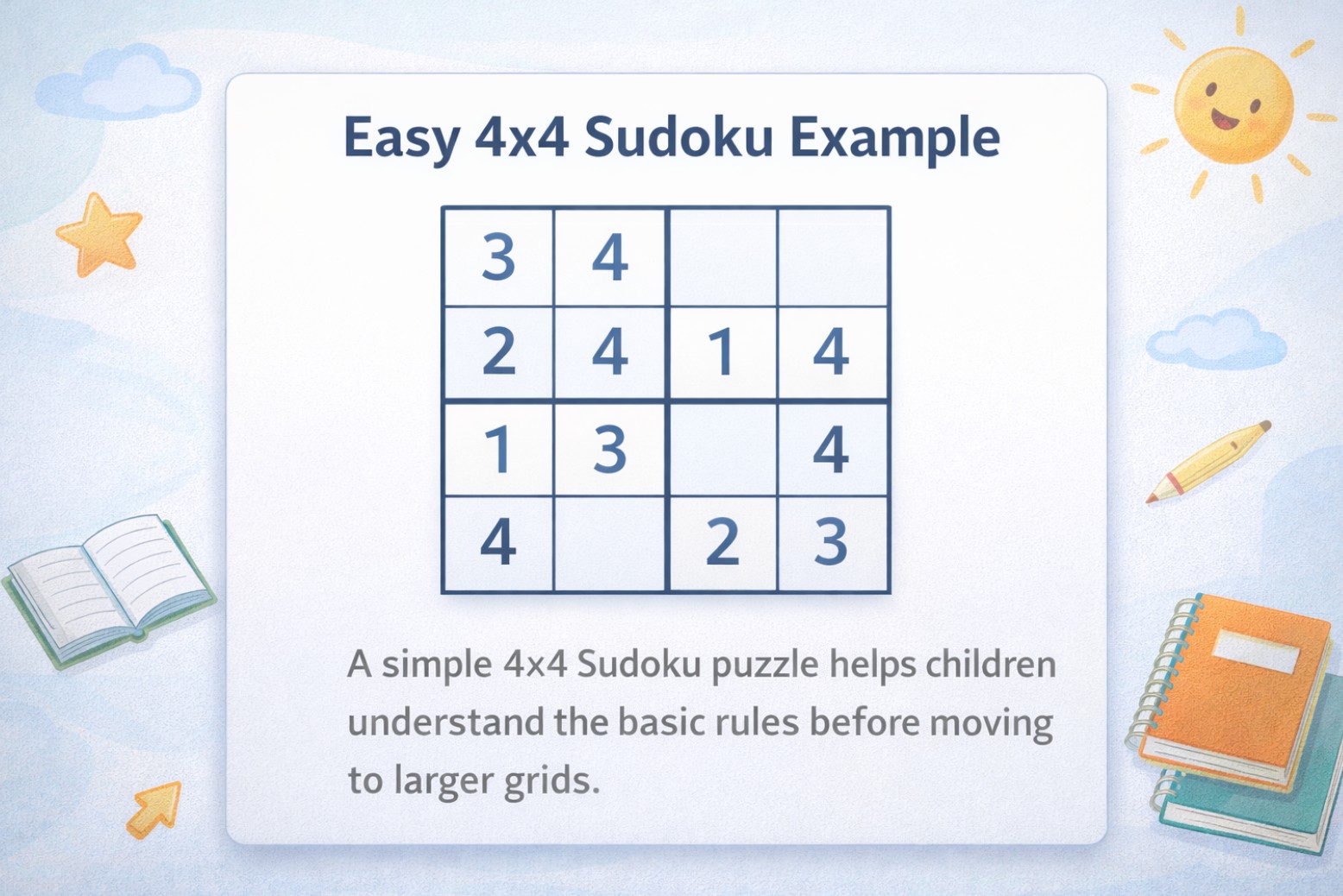
A simple 4×4 Sudoku puzzle helps children understand the basic rules before moving to larger grids.
The easiest way for children to understand Sudoku is to see a small example puzzle. Beginner Sudoku for kids often uses a 4×4 gridinstead of the traditional 9×9 puzzle. This simplified format helps young players learn the rules without feeling overwhelmed.
In a 4×4 Sudoku puzzle, children place the numbers 1 through 4 so that each number appears only once in every row, column, and box. Because there are fewer numbers to manage, beginners can focus on the basic logic of Sudoku and learn how the puzzle works step by step.
Once children understand how the smaller puzzle works, they can move on to larger Sudoku grids and more challenging puzzles.
Create Easy Sudoku Puzzles for Kids
Once children understand the basic rules of Sudoku, generating new puzzles becomes a great way to keep practicing. A Sudoku generator makes it easy to create fresh puzzles with the right difficulty level, clear layouts, and printable formats suitable for kids.
Instead of searching for individual puzzles online, parents, teachers, and puzzle creators can generate unlimited Sudoku puzzles designed specifically for young players. This allows you to control the grid size, difficulty level, and page layout while keeping the puzzles simple and easy to read.
Printable Sudoku pages are especially useful for classrooms, learning activities, travel games, and activity books. Because puzzles can be generated in batches, it is easy to build worksheet packs or complete puzzle collections for children.
Whether you are creating classroom worksheets, activity books, or fun logic exercises at home, generating Sudoku puzzles for kids provides a simple and engaging way to help children develop concentration and problem-solving skills.